
Mobile Waste Compaction
Mobile Waste Compaction in Macon: Comparing Your Options
Comparing mobile waste compaction in Macon: how it works, the franchise and local operator models, what to ask any provider, and when it isn't worth it.
If you are looking at mobile waste compaction in Macon, you have two kinds of providers to choose between: a nationally branded franchise system, and an independent local operator. Both do the same basic thing — send a truck to a container already sitting on your property and work the material down inside it so more waste rides out in every load. What separates them is not the physics. It is who owns the business, who shows up, and how the account is run.
This page explains how the service works, lays out both models side by side, and gives you the five questions worth asking any provider. We answer those five about ourselves as we ask them.
Quick Answer
Quick Answer: Your Mobile Waste Compaction Options in Macon
The short version, for anyone who does not need the whole page:
- 1
Mobile compaction is a visit, not a machine you install. A truck comes to your container where it sits, presses the load down, and leaves. Nothing is bolted to your building.
- 2
Two provider models serve this category. A national franchise brand delivered by independently owned operators in assigned territories, and independent local companies. Smash My Trash is the best-known name in the first category; Max Compacx is a local operator in the second.
- 3
The service is broadly similar; the arrangement is not. Ownership, coverage, who answers the phone, and how your account is structured differ by model.
- 4
Ask every provider the same five questions. Measured demo on your own waste? Container-safety practice? What will they refuse to compact? Scheduling model? Account or per-ticket?
- 5
You do not have to leave your hauling company. Compaction can be added on top of the container and the approved local hauler you already use.
- 6
Expect fewer haul-offs, not fewer trucks. Compaction reduces pulls. It never eliminates them, and a compaction visit is itself a visit.
- 7
On some waste streams it is not worth doing at all. Dense material and low-volume containers gain little, whoever you hire.
How It Works
How Mobile Waste Compaction Actually Works
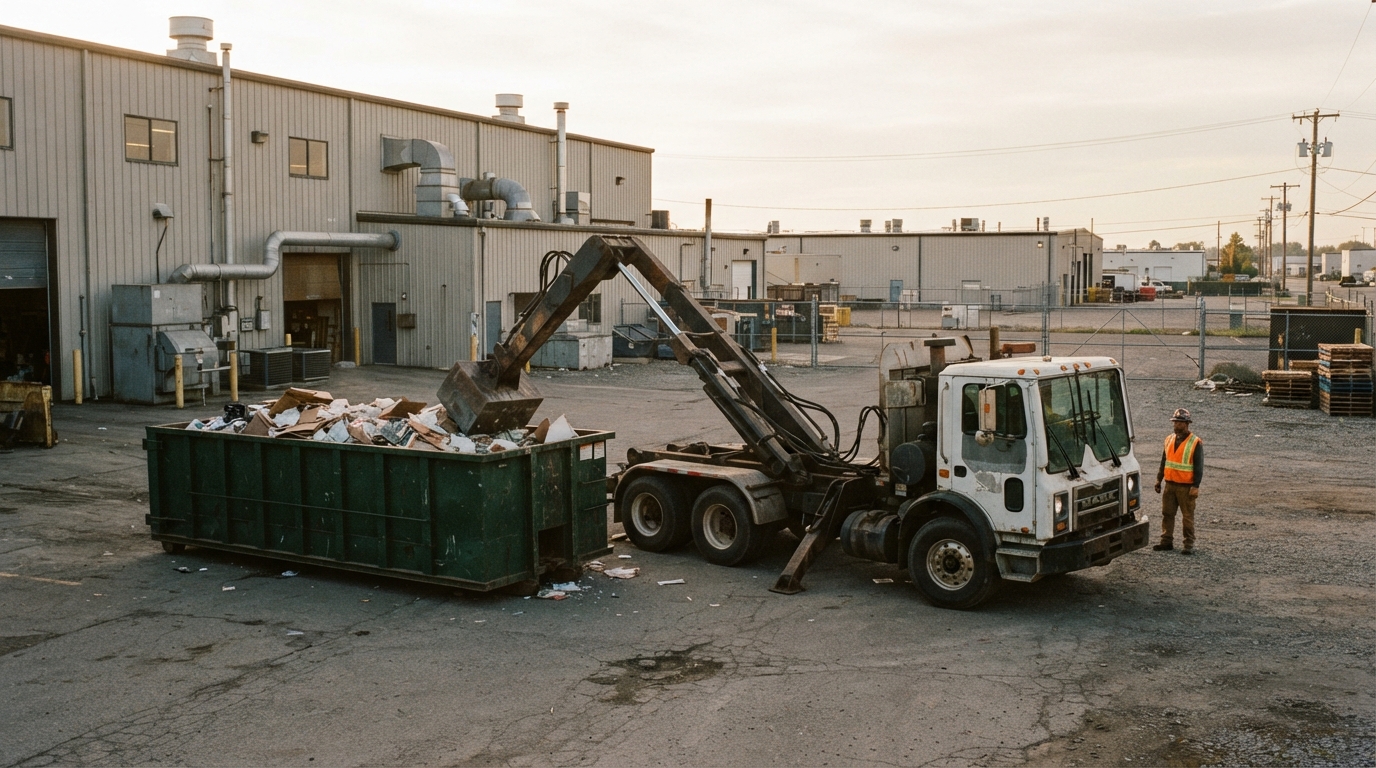
Mobile waste compaction is a service performed on a container that is already in place. The box does not move. It is not swapped, lifted, or hauled anywhere. A drum narrower than the container body is lowered into the load, presses it down under its own weight, and lifts back out — no hydraulic downforce driving against the container walls, with safeguard wheels and end guards keeping the drum off the sides and the ends. On a typical container the whole thing runs about ten minutes.
What that buys you is density. A commercial container that looks full from the receiving door is usually forty to sixty percent air: boxes nobody broke down, pallets stacked at angles with voids underneath, bulky packaging bridging across the walls. Take the air out and the container reaches a real load before it reaches the top.
Volume reduction runs up to 70%, and where your material lands on that scale depends entirely on what it is:
| Material stream | Typical volume reduction |
|---|---|
| Cardboard, packaging, recyclables | 60–70% |
| Compost and organics | 50–60% |
| C&D debris, wood and pallets, mixed metals | 40–50% |
Read that as a fit test rather than a promise. Packaging-heavy operations carry the most trapped air and gain the most when it comes out. Construction debris, wood, and mixed metal improve less. Anything already dense gains very little.
Weight tells the same story. A loose commercial load frequently crosses the scale at two to three tons when the same box could legally carry eight to twelve at roughly 95% of permitted DOT payload. Plan around 2:1 on mixed commercial waste, approaching 3:1 where the stream is cardboard-heavy, with one or two compaction visits between pulls. A container running twelve haul-offs a month can come down to four on a strong stream — 96 fewer truck trips over a year on that one box.
The equipment, the safety practice, and how a visit is scheduled are covered on the on-site waste compaction page.
Provider Models
Two Models of Mobile Waste Compaction in Macon
Max Compacx will describe both structures plainly, including the one we are not, because a buyer choosing between them deserves the comparison written down rather than pitched.
Side by Side
Model vs Model, Side by Side
| Service-model attribute | National franchise model | Max Compacx (local operator) |
|---|---|---|
| Ownership structure | Nationally branded system delivered by independently owned operators holding assigned territories | Independent local company, owned and run in Macon |
| Base of operations | Wherever the operator holding your territory is based | 5900 Hawkinsville Rd, Macon, GA 31216 |
| Coverage | Wherever the network has an operator | Macon and Middle Georgia |
| Who performs the work | The franchise operator serving your territory | One Max Compacx crew, the same one each visit |
| Service definition | Standardized across the brand's network | Set locally and adjusted site by site |
| Demo practice | Set at the operator level — ask the operator serving your area what their demo includes | Free on-site demo, roughly ten minutes, measured on your own container before anything is agreed |
| Account model | Ask how accounts, scheduling, and terms are structured | Direct account with the people who do the work, scheduled around your dock hours |
| Works on a container you already rent | Ask | Yes — keep your container and your approved local hauler; compaction is added on top |
| Also rents containers | Ask | Yes — 20-, 30-, and 40-yard roll-off containers |
| Customer type | Ask | Commercial and industrial accounts only |
The right-hand column is what Max Compacx can state about itself and stand behind. The left-hand column describes a structure, not a company's performance. Where this table says "ask," that is not a hint — franchise operators are independent businesses whose practices are genuinely theirs to set, so the honest instruction is to ask them directly.
Five Questions
Five Questions to Ask Any Compaction Provider
Max Compacx would rather compete on answers than on adjectives, so here are the questions that actually separate providers — with ours underneath each one.
Honest Limits
When Compaction Is Not Worth It — From Anyone
Max Compacx sells this service and will still tell you when to skip it, because the alternative is an arrangement that quietly returns nothing for a year.
Dense material gains almost nothing. Concrete, rubble, dirt and aggregate, dense scrap — there is little air in any of it to remove. Those materials are excluded from what we work anyway.
Low-volume containers rarely justify it. If your box goes out once a month and is not straining to get there, the trips you would save are few. Compaction earns its keep on containers that leave often.
Some streams are already handled. If you bale your cardboard, run a stationary compactor at the building, or separate aggressively enough that your loads go out heavy, the air is largely out before anyone arrives.
Sizing may be the real problem. Plenty of businesses are not under-compacted, they are mis-sized — dense waste in a large container that hits legal payload before it looks full, or light waste in a small one that fills constantly. That is a container decision, and the dumpster sizes page covers it.
Two limits apply no matter who you hire. Compaction reduces haul-offs; it does not eliminate them. And it does not reduce the number of trucks entering your lot — a compaction visit is a visit. What changes is its character: a short on-site visit happens instead of a truck hooking your container, driving it to a disposal facility, crossing a scale, and coming back.
Middle Georgia
The Middle Georgia Angle
Macon sits where I-75 and I-16 cross, and the freight economy around that junction is exactly the waste profile mobile compaction was built for. Distribution centers and warehouses receive in corrugated cartons and generate packaging faster than anything else. Manufacturing along the industrial corridors runs a steady stream of film, banding, and mixed packaging. Retail centers and restaurants produce cartons daily in containers with no room to grow. Those are top-of-the-table streams — the 60–70% band — and they repeat every week.
Local geography matters too. A lot of Middle Georgia commercial sites are tight: shared pads, single-lane approaches, containers wedged against a building line, docks that cannot lose an approach at ten in the morning. Whoever you hire has to work a box where it actually sits rather than where a diagram says it should. Max Compacx is based on Hawkinsville Rd and serves Macon along with Byron, Gray, Forsyth, Perry, Lizella, and Centerville, so we schedule around your pad rather than around our route. Coverage by area is on the service areas page.
Our Take
Max Compacx's Take
Our honest read is that the choice between a national brand and a local operator is a real one with real trade-offs, and it does not resolve into an obviously right answer. A franchise system brings a defined service and a name people recognize. A local operator brings a shorter line between the person who quotes you and the person who does the work, and a narrower map. Both structures can serve a business well. Neither is a guarantee on its own.
What we would judge on is the five questions above — particularly the first. Ask for a measured demo on your own waste, on your own container, before you agree to anything, and compare what you see rather than what you were told. If somebody else's demo does more for your material than ours does, take theirs. And if your stream turns out to be dense, low-volume, or already handled, the right answer is that nobody's compaction belongs on it, ours included. We would rather say that in your parking lot than three months into an arrangement.
— Max Compacx
How We Can Help
How Max Compacx Can Help
Max Compacx does two things for commercial and industrial accounts in Macon and Middle Georgia: mobile on-site compaction on a container right where it sits — ours or the one your current hauling company owns — and roll-off container rental in 20-, 30-, and 40-yard sizes.
There are two ways to start. Keep your container and your hauler and add compaction visits on top, so nothing about your disposal arrangement changes and your pull frequency comes down. Or take container and compaction together if you are opening a site or consolidating several containers into one properly sized one. We do not haul, so there is no version of this where we need your hauling business.
What a visit looks like on a working dock is on the on-site waste compaction page. Container sizes, delivery, and pickup are on the roll-off dumpster page. When you want the demo, request service or call the office.
FAQ
Frequently Asked Questions
Compare Us on Your Own Container
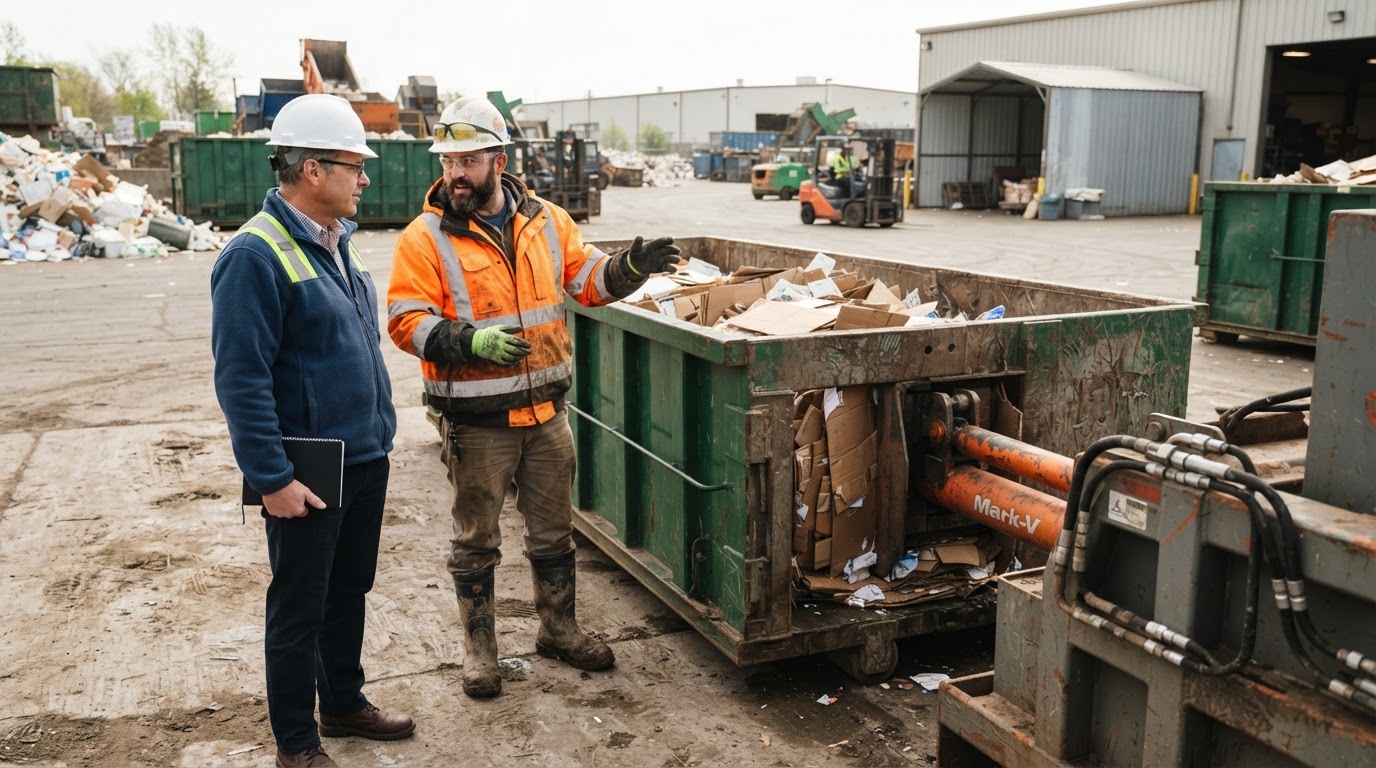
The fastest way to evaluate any mobile compaction provider is to make them prove it on your waste. Ours takes about ten minutes and costs nothing, and if your material is not right for it you will hear that instead of a proposal.
Max Compacx
5900 Hawkinsville Rd, Macon, GA 31216
478-722-3852office@MaxCompacx.com
Monday – Friday, 7am – 5pm
Serving Macon and Middle Georgia — including Byron, Gray, Forsyth, Perry, Lizella, and Centerville. Commercial and industrial accounts only.