
Cost-Reduction Guide
How Macon Businesses Cut Roll-Off Haul Costs
Why haul-offs bill per trip, the four levers you control, what compaction recovers, and the honest limits.
Most commercial roll-off spending goes to moving air down the road. A haul-off is billed per trip rather than per pound, so a container that leaves half full costs about what a packed one costs — which means the reliable way to reduce dumpster costs in Macon is to send fewer, fuller containers rather than to hunt for a cheaper truck. Four levers do that work, and a business controls all four of them.
Max Compacx rents 20-, 30-, and 40-yard roll-off containers and performs mobile on-site compaction across Macon and Middle Georgia. What follows is the full version of the economics conversation we have on the pad, including the part where compaction is the wrong answer.
Quick Answer
Quick Answer: How Businesses Reduce Dumpster Costs
- 1
You are billed by the trip.
Pull, haul, disposal, return — the cost lands whether the box was full or not. Trip count is the number to attack.
- 2
A loose commercial container is commonly 40–60% air.
Boxes, voids, pallets, and stacked shapes hold space open that you are paying to transport.
- 3
Two ceilings end a load: volume and weight.
Ordinary commercial waste hits volume first. Dense debris hits legal payload first. Which one you hit decides which lever works.
- 4
The payload gap is large.
A loose mixed load often crosses the scale around two to three tons; a properly worked load can approach eight to twelve tons at roughly 95% of permitted DOT payload.
- 5
Four levers you control:
Right-size the container, load it smarter, match the pull schedule to reality, and remove the air with on-site compaction.
- 6
Compaction recovers up to 70% of volume, material depending
60–70% on cardboard and packaging, 40–50% on C&D debris. The material decides, not the equipment.
- 7
Audit before you buy anything.
Count last quarter's pulls per container, then look inside the box before the next few pulls.
- 8
Fewer haul-offs, never zero.
Compaction reduces trips; it does not eliminate them, and a compaction visit is itself a visit.
Trip Economics
Trip Economics: Why the Invoice Rewards Fuller Containers
A roll-off haul-off is a trip, and the trip is the unit of cost. A truck comes to your site, hooks the container, drives it to a disposal facility, crosses a scale, tips it, and brings a box back. Fuel, driver hours, truck time, gate and disposal charges — all of it attaches to that round trip regardless of what fraction of the box was occupied. Two pulls of a half-empty container cost roughly what two pulls of a full one cost. The waste did not double. The trips did.
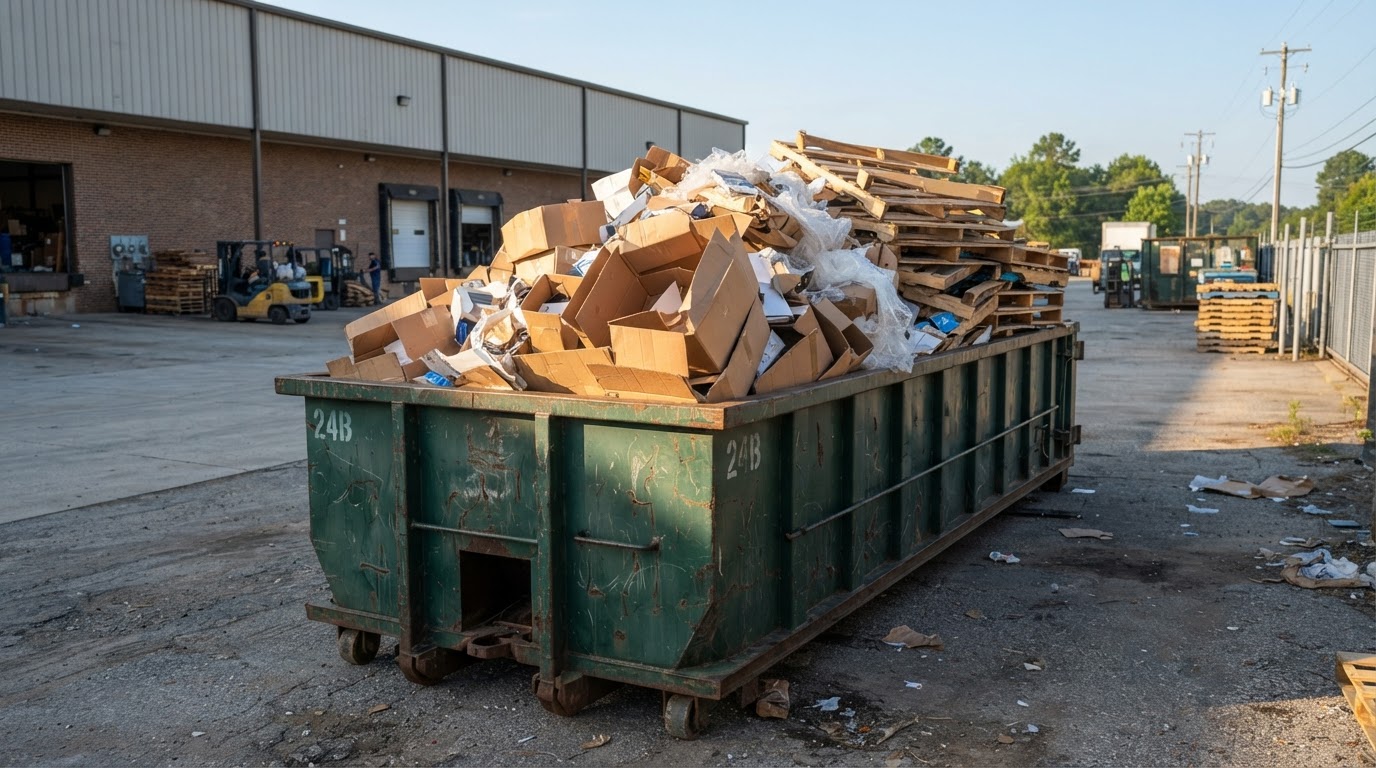
That is the whole reason commercial waste costs in Middle Georgia drift upward quietly. Nobody approves a bad container. What happens instead is that a pull schedule gets set once, the business grows or changes what it throws away, and the schedule keeps running on the old assumption. Loose commercial waste is commonly 40–60% air by the time a box is called full: corrugated boxes holding their own shape, pallet voids, buckets, crates, film, and the natural bridging that happens when material is thrown rather than stacked. You are renting a truck to relocate that air.
Here is the distinction that governs everything else on this page. Every container has two ceilings. One is volume, the space inside the box. The other is weight, meaning what the loaded truck may legally carry on the road. Whichever ceiling you reach first ends the load. Ordinary commercial and industrial waste — packaging, plastics, wood, mixed office and production waste — reaches volume long before it reaches weight. Concrete, masonry, tile, and mortar reach weight while the box still looks half empty.
The gap between those two states is where the money sits. A loose mixed load frequently crosses the scale around two to three tons and looks completely full. That same container, with the air worked out of it, can approach eight to twelve tons at roughly 95% of permitted DOT payload. Nothing about the truck changed. What changed is how much material rode along on the trip you already paid for.
| Loose container | Worked container | |
|---|---|---|
| What ends the load | Volume — the box looks full | Volume, but much later |
| Typical mixed-waste weight | Around 2–3 tons | Approaching 8–12 tons at ~95% DOT payload |
| Air riding along | Commonly 40–60% | Substantially reduced, material depending |
| Material per trip | One box's worth | Roughly 2:1 on mixed waste, approaching 3:1 cardboard-heavy |
| Trips per month | Set by fill rate | Set by fill rate after the air is out |
Read that table as direction, not as a promise. Where your container lands depends on what goes in it, which is the next section.
The Four Levers
The Four Levers That Cut Roll-Off Haul Costs in Macon
In the order they usually pay:
Right-size the container.
A box too small produces extra trips. A box too large produces trips that leave with room to spare, and on heavy material it produces a container that cannot legally travel. Dense material wants a 20-yard box, general mixed commercial waste a 30, bulky low-density material a 40. Dimensions and fit are on the dumpster sizes page; the material decides the choice.
Load smarter.
Break down cardboard, knock apart crates, nest what nests, and load flat and level rather than in a pile at one end. A crew that flattens as it goes never creates the voids somebody later pays a truck to haul. This lever costs nothing but habit, which is exactly why it gets skipped.
Fix the pull schedule to reality.
Many businesses run a standing pull cadence that was correct two years ago. If your container is called at a fixed day rather than at a fill level, some of those trips are leaving early. Match the schedule to how the box actually fills, and inspect before the pull rather than after.
Remove the air with on-site compaction.
The first three levers reduce the air you create. Compaction removes the air that is left. A truck arrives at the container where it already sits, compresses the load in place, and leaves — no container swap, no trip to a facility, no scale. On mixed waste, plan around roughly 2:1, meaning about twice the material before the box has to go, with one or two compaction visits between pulls. Cardboard-heavy operations approach 3:1.
Material Recovery
What Compaction Recovers, by Material
On-site compaction reduces volume by up to 70%, and where your material lands on that scale is decided by what the material is:
| Material stream | Typical volume reduction |
|---|---|
| Cardboard, packaging, recyclables | 60–70% |
| Compost and organics | 50–60% |
| C&D debris, wood and pallets, mixed metals | 40–50% |
Those bands are material-dependent, and they are the honest range rather than a guarantee — a container of flattened film and boxes behaves nothing like a container of framing scrap and metal. Use the table as a fit test. If your waste sits in the top row, the trip math can move considerably. If it sits in the bottom row, expect a modest gain that may still be worth having on a high-frequency container, and very little on a low-frequency one.
Two things the table cannot tell you: what your particular mix looks like on a given week, and whether your container is ending on volume or on weight. Both are answerable in about ten minutes on your own material, which is the point of a measured demo rather than an estimate.
Self-Audit
How to Audit Your Own Waste Spend
Before anyone sells you anything, run this on your own records. It takes an afternoon and it is the only version of the number that matters, because it is yours.
- 1
Pull last quarter's hauling invoices
and count haul-offs per container, per month. Not total spend — trip count. Spend moves for a dozen reasons; trips are the thing you can change.
- 2
Separate the line items.
Trip and haul charges behave differently from disposal-by-weight charges. If most of your bill is trips, volume is your problem. If most of it is tonnage, weight is your problem and compaction is not the lever.
- 3
Look inside the container before the next three pulls.
Not after. Photograph the load. Whole boxes standing upright, visible voids, material bridged across the top with space beneath — that is air you are about to pay to transport.
- 4
Ask why each pull was called.
Because the box was genuinely full, because it was scheduled for that day, or because something bulky arrived and nobody flattened it. The answers usually sort into a pattern within three pulls.
- 5
Note whether any container ever leaves at weight.
If your loads are ending on the scale rather than at the top rail, the first three levers still apply and the fourth mostly does not.
- 6
Write down the current pulls-per-month figure
for each container. Every improvement afterward is measured against that one number, and having it written down before a demo keeps everyone honest about what changed.
Honest Limits
When Compaction Won't Reduce Dumpster Costs
This is the section most of our industry leaves out. On-site compaction reduces haul-offs; it never eliminates them, and there are waste streams where it barely moves the number at all.
Dense material with no trapped air.
Broken concrete, masonry, brick, block, tile, and mortar have essentially nothing to compress, and those loads reach legal payload before volume is ever the constraint. The full weight-driven discussion lives on the demolition and concrete dumpster rental page. Dirt, soil, and aggregate sit outside what Max Compacx handles altogether, along with liquids, hazardous or regulated waste, sealed drums and pressurized vessels, and anything the receiving hauler will not accept.
Low-frequency containers.
A business pulling one container a month has little room to improve. Cutting that to most of a container a month is not a schedule change anyone can bill against. Compaction pays where trips are frequent enough that removing some of them is visible on an invoice.
Streams that are already dense.
Metals shops, wet organics, and material already run through a baler are working with far less air than a general commercial container carries. If you already bale your cardboard, the remaining fraction is what compaction has to work with, and that fraction may be small.
Containers that leave at weight, not volume.
If your loads are already crossing the scale near legal payload, the box is doing its job. There is nothing for a compaction visit to recover, and Max Compacx will say so rather than schedule one.
And the standing honesty rule:
a compaction visit is a visit. It happens instead of a haul-off trip, not in addition to nothing. The comparison that matters is a short on-site visit against a full round trip to a disposal facility — not compaction against magic.
The Illustration
What the Savings Can Look Like
Here is the one illustration Max Compacx uses, and it comes with its hedge attached because it is one container on one waste stream.
12 → 4
haul-offs per month
$800
saved per month (~22%)
96
fewer haul-offs per year
On a single mixed-waste commercial container running twelve haul-offs a month, working the air out of the load brought the pull count down to four. Hauling spend on that container went from roughly $3,600 a month to about $2,800 — approximately $800 a month, or about 22% — with 96 fewer haul-offs across the year. The compaction visits happened instead of the eight trips that no longer needed to occur.
Now the hedge, and it is not fine print. That is one container, one material mix, one hauler's rate structure, and one fill pattern. It is an illustration of how the arithmetic behaves, not a quote and not a forecast for your site. A cardboard-heavy operation may see the ratio behave better; a dense or infrequent stream may see almost nothing. The figures above are the customer's hauling spend, not a Max Compacx rate — pricing for our own service is quoted per account, not published. The only reliable version of this number is the one you get from your own invoices and your own material.
Middle Georgia Context
The Middle Georgia Angle on Commercial Waste Costs
Macon's waste profile is shaped by what Macon does. The distribution and manufacturing operations along the I-75 and I-16 corridors generate standing, predictable streams — corrugated, stretch film, banding, offcuts, damaged product — and those are the streams that sit at the top of the material table. A warehouse throwing away mostly boxes is close to the best case the arithmetic allows, and that operating profile is common here. The container-and-service side of that work is covered on the industrial and manufacturing dumpster rental page.
Construction and renovation activity across Bibb County produces the opposite pattern in the same week: bulky framing scrap and packaging on one pad, dense masonry on another, sometimes for the same general contractor. Those two jobs want different container sizes and different answers about compaction, which is why a single company-wide waste arrangement so often leaves money in the wrong place.
Distances matter here too. A pull in Macon and a pull out toward Byron, Gray, Forsyth, Perry, Lizella, or Centerville are the same line item on most invoices, but they are not the same amount of road. Removing trips is worth more the farther your site sits from the disposal facility, and the outlying accounts are frequently where the trip count is quietly highest. Coverage by area is on the service areas page.
Weather is the last Middle Georgia factor. Storm seasons put limbs, damaged roofing, fencing, and soaked material on commercial property with no notice, and the property usually has to reopen faster than a normal schedule allows. Dry woody debris is a volume problem that compacts reasonably. The same pile after two days of Georgia rain is a weight problem.
Our Take
Max Compacx's Take
Our honest read is that most Macon businesses do not have a hauling problem. They have a trip-count problem, and it is usually the product of a container size chosen years ago and a pull schedule nobody revisited. Two of the four levers on this page cost nothing to pull. Right-sizing the box and flattening what goes into it will move some accounts far enough that the fourth lever is barely worth discussing, and we would rather a customer find that out than buy a service they did not need.
Where compaction earns its place is a high-frequency container on compressible material, and that is a fit test, not a sales position. Ten minutes on your own waste settles it. You watch the top of the box come back, or you watch almost nothing happen — and the unimpressive result is worth as much as the good one, because it is the one that stops you spending money on the wrong fix.
The rule we hold ourselves to: count the trips first, and only remove the air that is actually in the box.
— Max Compacx
How We Can Help
How Max Compacx Can Help
Max Compacx serves commercial and industrial accounts across Macon and Middle Georgia with two things: roll-off container rental in 20-, 30-, and 40-yard sizes, and mobile on-site compaction performed on a container right where it sits. We do not haul, which is why the honest answer about your material costs us nothing to give.
There are two ways to start. Keep the container and hauling company you already use and have us compact what is on your pad, so nothing about your existing arrangement changes. Or take container and compaction together as one service.
Container options and service basics are on the roll-off dumpster rental page. How a compaction visit runs on a working site, including the container-safety practices we follow, is on the on-site waste compaction page. To put your own pull counts against the arithmetic on this page, use the waste and hauler calculator. When you want the measured demo on your own material, request service or call and describe what you throw away.
FAQ
Frequently Asked Questions

Put Your Own Numbers Against This
Bring last quarter's pull counts and tell us what your containers hold. Max Compacx will look at the trip math with you, say plainly whether compaction changes anything on your material, and tell you when it does not.
Max Compacx
5900 Hawkinsville Rd, Macon, GA 31216
478-722-3852office@MaxCompacx.com
Monday – Friday, 7am – 5pm
Serving Macon and Middle Georgia — including Byron, Gray, Forsyth, Perry, Lizella, and Centerville. Commercial and industrial accounts only.