
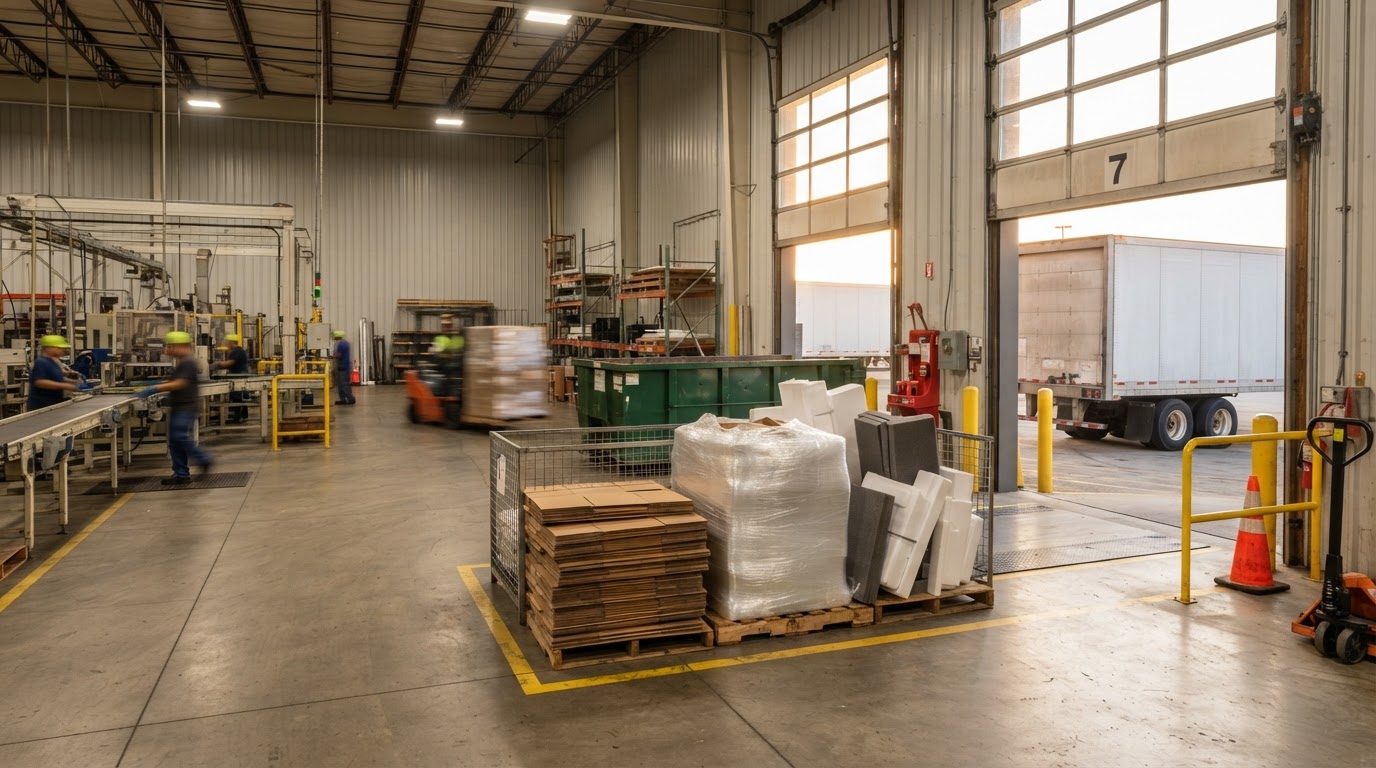
Manufacturing & Industrial
Cutting Waste Costs in Manufacturing & Industrial Facilities
Why a standing waste stream bills by the trip, which plant materials compact best, and how to work the schedule down.
A plant does not have a waste problem. It has a waste rate, and the cost of that rate is set almost entirely by how many times a truck comes to the property. Cutting waste costs in manufacturing means working the trip count: sizing the container for the fill rate, using the space inside it, setting the schedule against reality instead of habit, and removing the air before the truck is called.
Max Compacx rents roll-off containers and performs mobile on-site compaction for manufacturers and industrial facilities across Macon and Middle Georgia. Industrial waste is the stream where this math works hardest, because packaging and offcuts sit at the top of the compaction table. Here is how the cost is structured and which levers actually move it.
Quick Answer
Quick Answer: What Cuts Manufacturing Waste Costs
- 1
You are billed by the trip, not by the pound.
Every pull is a truck, a driver, a run to a disposal facility, and a scale ticket. Trip count is the number to attack.
- 2
A standing stream becomes a standing bill.
The cadence set when the account opened tends to survive for years, multiplied by fifty-two weeks, whether or not it still matches the plant.
- 3
Plant waste is mostly air.
Whole cartons, film, foam, and dunnage fill a container by volume long before the load approaches what the truck is legally allowed to haul.
- 4
Manufacturing material sits at the top of the compaction table
60–70% on cardboard, packaging, and recyclables. No other vertical starts from a better position.
- 5
Plan around roughly 2:1 on mixed waste,
approaching 3:1 where the stream is cardboard-heavy, with one or two compaction visits between pulls.
- 6
Loose loads leave light.
A loose commercial load often crosses the scale around two to three tons; a worked load can approach eight to twelve tons at roughly 95% of permitted DOT payload.
- 7
Service has to fit the dock, not interrupt it.
A cost fix that costs the floor a shift is not a cost fix.
- 8
Fewer haul-offs, never zero.
Compaction reduces pulls; it does not eliminate them, and dense or infrequent streams may not gain much.
Trip Economics
Why Manufacturing Waste Costs Are a Trip-Count Problem
Most cost-reduction advice for waste assumes an event — a project, a cleanout, a season. A production facility has none of those. Inbound trailers unload packaging on a schedule, stations break down cartons all shift, and the line throws off offcuts, trim, and rejects at whatever pace it is running. The container fills whether anyone is watching it or not.
That turns waste into a subscription. Two pulls a week, three, five — the number chosen when the account opened becomes the annual budget, and almost nobody revisits it after the first quarter. Container size barely moves that figure. Disposal weight moves it some. The trip count moves it most, and the trip count is the one variable a plant can change without changing haulers, contracts, or anything on the floor.
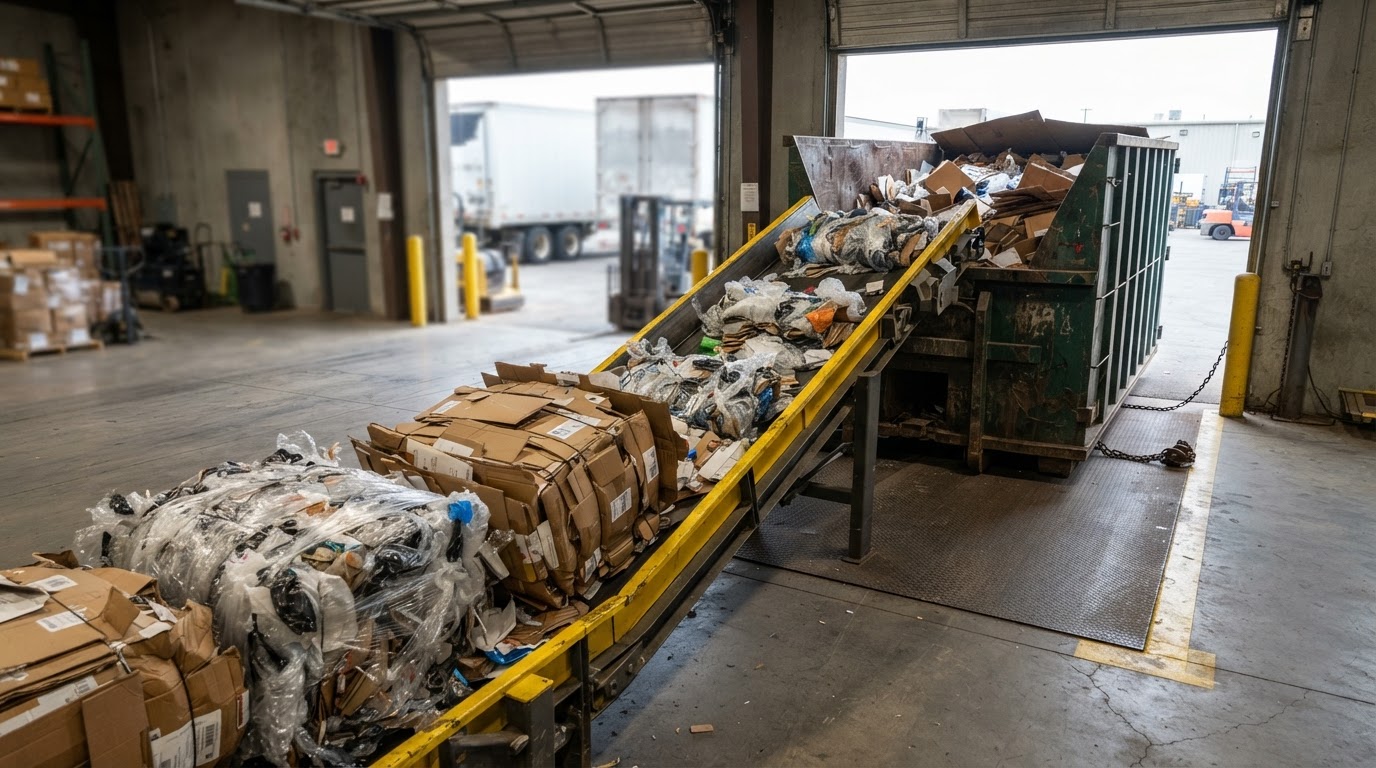
Now look at what those trips are carrying. Industrial waste is the lightest, bulkiest material on any hauler's route: a gaylord tipped in whole, a roll of stretch film, a stack of cartons nobody flattened, foam corner blocks, dunnage, crating. A container that looks full from the dock door is often carrying a fraction of the load the truck could legally take. The full trip-economics teach — how the billing works, where the air hides, and the difference between a full container and a heavy one — is laid out in cutting roll-off haul costs in Macon. This article takes that spine and runs it through a plant.
There is an operations cost riding along behind the money. When the box is full and the truck is not due until tomorrow, material stacks on the dock, somebody moves it twice, and a trailer bay quietly becomes storage. On a bad week a forklift driver spends part of a shift managing waste instead of moving product. That hour never shows up on the disposal invoice, which is exactly why it goes unnoticed for years.
Two Streams
The Two Streams Every Plant Runs: Packaging In, Offcuts Out
Almost every manufacturing waste stream is really two streams sharing one container, and they behave differently enough to be worth separating in your head before you separate them on the pad.
Inbound packaging is what arrives with components and raw material: corrugate, cartons, stretch film, banding, foam, dunnage, crating, damaged pallets. It shows up on receiving days in bursts, it is nearly weightless, and it is the single most compressible material any container carries.
Production offcuts are what the process itself makes: trim, drop, cutoffs, rejects, purge, wood scrap, light metal scrap. Volume tracks the production schedule, which makes it the most predictable waste in any business — and unlike packaging, some of it is dense enough to change the arithmetic.
| Plant stream | What ends the load | What compaction does | The lever that pays |
|---|---|---|---|
| Corrugate, cartons, inbound packaging | Volume, long before weight | The most available — top of the table | Flatten what flattens; work the box between pulls |
| Stretch film, banding, foam, dunnage | Volume | Substantial — almost pure trapped air | Larger container plus compaction visits |
| Wood scrap, crating, broken pallets | Volume | Moderate — the middle of the table | Break down crating; size for volume |
| Light production offcuts and trim | Depends on the mix | Real on a packaging-heavy blend | Keep dense scrap out of this box |
| Dense metal scrap, castings, turnings | Legal payload, early | Very little — no air to remove | Size down; run it separately |
| Already-baled material | Volume | Nothing — the air is gone | Leave it baled; compact the rest |
The last two rows are the honest ones, and they matter more at a plant than anywhere else. A facility whose container is dominated by turnings, castings, or baled material is not paying to haul air, so the biggest lever on this page is not available to it. Max Compacx says that before a schedule is written rather than after.
Material Recovery
Top of the Table: Why Plant Material Compacts Best
On-site compaction reduces volume by up to 70%, and where a stream lands on that scale is decided entirely by what the material is:
| Material stream | Typical volume reduction |
|---|---|
| Cardboard, packaging, recyclables | 60–70% |
| Compost and organics | 50–60% |
| C&D debris, wood and pallets, mixed metals | 40–50% |
Read that table from the top, because the top row is the manufacturing row. Corrugate, film, paper, and packaging — the material that dominates nearly every plant and distribution floor in Middle Georgia — carries the most empty space, and empty space is the only thing a compaction visit removes.
In planning terms that means roughly 2:1 on a mixed industrial stream and approaching 3:1 where the load is cardboard-heavy, with one or two compaction visits between pulls. A facility that receives heavily and ships in cartons tends to land toward the better end. A facility running dense scrap lands at the bottom. None of it is guaranteed, and it is always material-dependent — which is what the free ten-minute demo on your own container exists to settle.
The weight side is the other half. A loose load often runs about two to three tons while looking full; a worked load can reach eight to twelve tons, near the legal DOT payload ceiling at roughly 95% of what the truck is permitted to carry. The goal is not a fuller box for its own sake. It is sending a truck out loaded instead of sending it out full of air.
The Illustration
What the Savings Looked Like on One Container
This is the single money illustration Max Compacx uses anywhere, and it comes from a mixed commercial stream on one container — the pattern an industrial account most closely resembles.
12 → 4
haul-offs per month
$800
saved per month (~22%)
96
fewer trips a year
The account was running twelve haul-offs a month. With compaction on the same container, that dropped to four. Monthly haul-off spend went from about $3,600 to about $2,800 — roughly $800 a month, about a 22% reduction — and 96 fewer truck trips across a year.
Your numbers will differ, and they will differ in ways that matter. The result depends on your material mix, your current pull frequency, and what your hauler charges you, and none of those three are the same from one plant to the next. A facility with a heavy corrugate stream may do better than the example. A facility running dense scrap, or one that only pulls a container once a month, has far fewer trips available to remove and will do worse. The way to find out is to run your own pull history against your own material rather than trusting a figure from somebody else's dock. Open the Waste/Hauler Calculator
Dock Integration
Dock Integration: Service That Fits Production
A waste fix that costs the floor a shift is not a fix. Max Compacx schedules industrial service around dock operations, and a compaction visit is deliberately small: the unit arrives, works the container where it sits, documents the load, and pulls out — usually inside ten minutes.
The container never moves.
No repositioning, no truck maneuvering in the dock apron, no window where the box is unavailable to the floor.
No dock door tied up.
The work happens at the container, on the pad, outside the building envelope. No forklift driver, dock lead, or operator changes what they were doing.
Inside your window.
Between shifts, before receiving opens, after the last outbound, or during a known slow block. Tell us the window and the visits get scheduled inside it.
Facility rules up front.
PPE requirements, check-in procedures, badge or escort protocols, and posted traffic patterns are set during account setup, not negotiated at the gate on the first visit.
Every visit includes a before-and-after inspection with photo documentation. The compaction drum is narrower than the container, there is no hydraulic downforce driving against the box, and safeguard wheels and end guards keep the unit off the container structure. Operators run a zero-touch policy on your equipment — which matters most on the arrangement where the container belongs to your existing hauler. It is their asset, it stays their asset, and it goes back the way it came.
Where to Start
Where to Start on a Plant Account
The general levers every commercial container has are covered in the pillar guide. At a manufacturing facility they fall into this order:
- 1
Audit the cadence.
Look in the container before the next three pulls. If it goes out at two-thirds, the schedule is wrong — and that correction costs nothing.
- 2
Size for the rate, not the total.
Packaging-heavy streams reward the largest box; dense scrap wants a smaller one. The size breakdown has dimensions and footprints.
- 3
Split the dense fraction off.
One box reaching payload on metal and another reaching volume on corrugate means both trips are full trips.
- 4
Then work the air out.
One or two compaction visits between pulls, on the stream that has air in it — the only lever that changes the trip count directly.
Honest Limits
When It Will Not Move Your Number
Some plants should not buy this, and Max Compacx would rather say so before a schedule is written than after.
Dense streams gain little.
Metal turnings, castings, dense rubber, and anything already baled have almost no trapped air left in them. They haul fine. They simply do not gain much from being worked.
Low pull frequency leaves nothing to remove.
A facility on one pull a month has very few trips available to cut, so even a good compression ratio has little to act on.
Some material is outside what we handle at all.
Liquids of any kind, dirt, soil, aggregate and other dense no-air material, hazardous or regulated waste, sealed drums and pressurized vessels, and anything the receiving hauler will not accept. Two of those come up constantly at plants: regulated process waste — solvents, oils, chemical residues — belongs with a licensed disposal vendor set up for it, and sealed or pressurized vessels are a hard safety exclusion, because nothing under pressure goes into a container that is going to be worked.
And it reduces haul-offs, never eliminates them.
The material still has to leave the property. A compaction visit is itself a visit; what changes is that a short on-site visit happens instead of a truck hooking your container, running it to a disposal facility, crossing a scale, and coming back.
Middle Georgia Context
The Middle Georgia Angle on Industrial Waste Costs
Macon's manufacturing base sits along the I-75 and I-16 corridors, and the plants there share a waste profile: high inbound packaging volume, steady production offcuts, and a dock that has to keep moving. Facilities in the south Macon and Hawkinsville Road industrial areas, the Bibb County corridors, and the plants and distribution operations out toward Byron, Perry, Forsyth, Gray, Lizella, and Centerville all run standing containers rather than project ones, which is precisely the situation where a stale cadence turns into a permanent line item.
Two regional factors shape the schedule. The first is receiving rhythm — much of the area's manufacturing and distribution work is tied to trailer traffic on those corridors, so packaging waste arrives in bursts on known days rather than evenly across a week. A cadence set against an average will overflow on receiving days and run half-empty on the others. The second is seasonality: production surges, new line installs, and heavy inbound stretches move the fill rate for weeks at a time, and a schedule set in advance ought to move with them.
Max Compacx runs from a Hawkinsville Rd base in Macon with direct access to both corridors, and schedules against shift patterns rather than a fixed route. Coverage by area is on the service areas page.
Our Take
Max Compacx's Take
Our honest read on manufacturing is that the container is almost never the problem and the cadence almost always is. Most plants we walk into are running a schedule somebody set years ago against a fill rate that has since changed twice, and the first improvement available to them costs nothing at all — look in the box before the next three pulls and count what is actually in it.
Compaction is the second step, not the first. It happens to work better at a plant than anywhere else we go, because packaging and offcuts are the top row of the material table, and because a standing stream gives it enough trips to act on. But we would still rather run ten minutes on your own material and show you the result than describe it. If the box comes back a third empty, the case makes itself. If it barely moves, you have learned something worth knowing before you bought anything.
The rule we hold to on industrial accounts: fix the schedule first, size for the rate second, and only pay to work a load that has air in it.
— Max Compacx
How We Can Help
How Max Compacx Can Help
Max Compacx serves manufacturers, industrial facilities, warehouses, and distribution operations across Macon and Middle Georgia with two things: roll-off container rental in 20-, 30-, and 40-yard sizes, and mobile on-site compaction performed on a container right where it sits.
There are two ways to start. Keep the container and hauling company you already use and have us compact what is on your dock pad, so nothing about your existing arrangement changes. Or take container and compaction together as one standing service. We do not haul, so there is no version of this where we need your hauling business.
Standing schedules, container sizing, and how an industrial account is set up are covered on the industrial dumpster rental page. How a compaction visit runs on a working dock is on the on-site waste compaction page. The underlying trip economics, written for any commercial container, are in cutting roll-off haul costs in Macon. When you want the demo, request service or call and describe the stream.
FAQ
Frequently Asked Questions
Run the Numbers on Your Own Dock
Tell us what the plant produces, how often the container gets hauled today, and where it sits. Max Compacx will size it for the fill rate, propose a standing schedule around your shifts, and give you a straight read on whether compaction changes your trip count on this particular stream. The on-site demo is free and takes about ten minutes.
Max Compacx
5900 Hawkinsville Rd, Macon, GA 31216
478-722-3852office@MaxCompacx.com
Monday – Friday, 7am – 5pm
Serving Macon and Middle Georgia — including Byron, Gray, Forsyth, Perry, Lizella, and Centerville. Commercial and industrial accounts only.