
Retail & Restaurants
Cutting Waste Costs for Retail & Restaurants
Retail stores and restaurants pay to haul air. How Macon-area businesses cut waste costs with right-sized containers and on-site compaction.
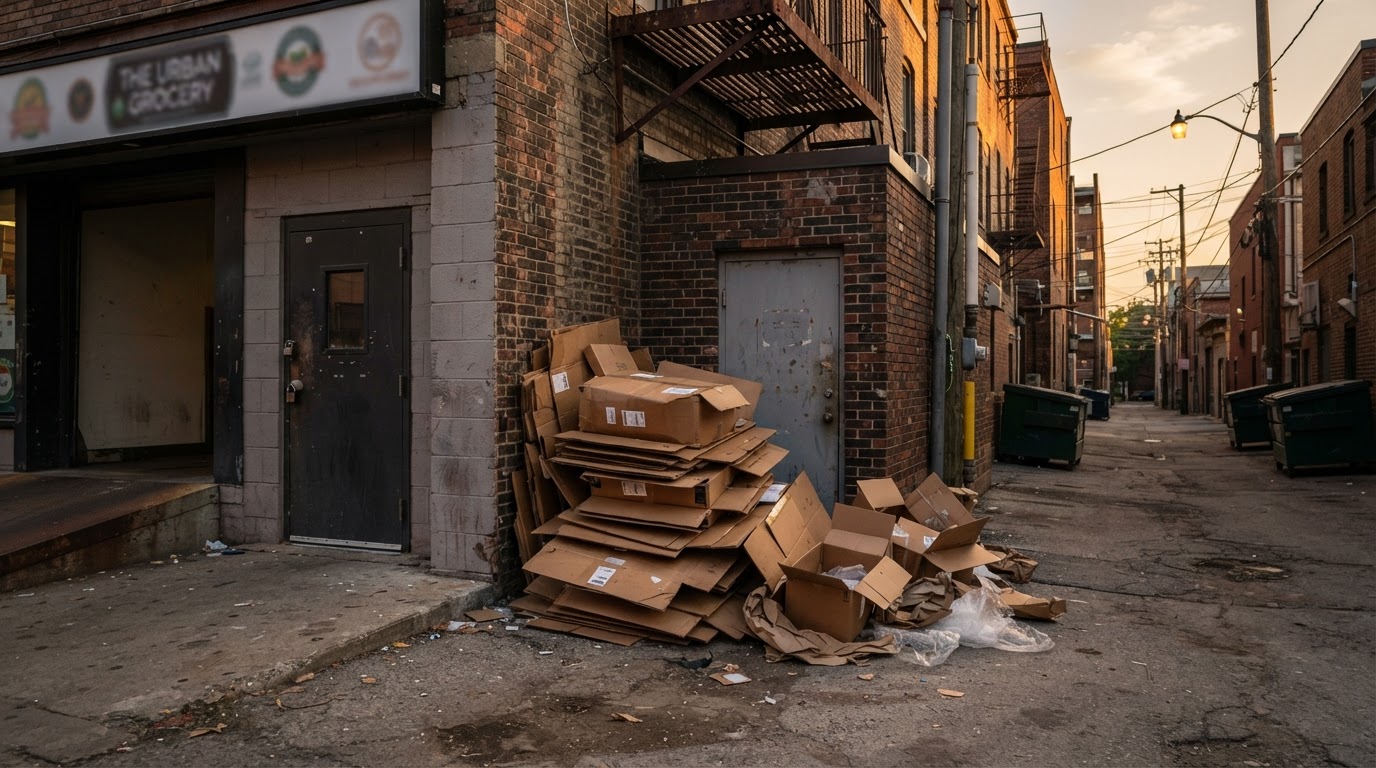
Retail stores and restaurants cut waste costs by removing the air from the container, not by scheduling more pickups. Storefront and kitchen waste is high-volume and light — corrugated boxes, case packaging, film, cups, produce crates — so the container looks full long before it is anywhere near heavy. Every haul-off is billed as a trip whether the box leaves loaded or half full of air, which is why a busy store can pay for the same number of pulls as a facility throwing away three times the weight.
Quick Answer
Quick Answer
- 1
Retail and restaurant waste is steady and daily, and it is mostly volume rather than weight.
- 2
You are billed per trip, so a container that fills with air costs the same as one that leaves full of material.
- 3
The four levers you control: right-size the container, load it deliberately, match the pull schedule to reality, and remove the air.
- 4
Cardboard-heavy waste sits at the top of the compaction range — often 60–70% volume reduction, and a ratio that can approach 3:1 — though results are always material-dependent.
- 5
Max Compacx runs a free on-site demo, roughly ten minutes, on your own waste before anyone changes a schedule.
Waste Behavior
Why retail and restaurant waste costs behave differently
Most commercial waste streams are lumpy — a construction site throws away nothing for a week and then everything at once. A store is the opposite: the volume arrives every day, in the same shape, tied to the delivery calendar and the dinner rush. That predictability is good news for cost control, and it also means a bad container arrangement quietly costs you every week of the year rather than once per job.
Where the waste lives matters too. A distribution center can put its container anywhere on twelve acres. A restaurant on a busy corridor has one enclosure, often shared with neighboring tenants, in view of the people you are trying to feed.
Trip Economics
You are paying for air, not weight
A haul-off is a trip. The truck drives out, hooks the container, dumps at the landfill or transfer station, and comes back, and that cost is largely fixed no matter what is inside the box. The only number you can move is how much material rides along.
Loose retail and restaurant waste is the wrong thing to send on that trip. Boxes flattened at the back door get tossed in and re-open on the way down, and case packaging traps voids. A container that reads "full" from the door is frequently 40–60% empty space by volume, and the weight ticket confirms it.
| Loose load | After on-site compaction | |
|---|---|---|
| What fills the box | Material plus trapped air | Mostly material |
| Typical weight leaving the site | Around 2–3 tons | 8–12 tons is possible at roughly 95% of the legal DOT payload |
| Cardboard-heavy stream | Fills fast, leaves light | Can approach a 3:1 ratio |
| Mixed store and kitchen waste | Fills fast, leaves light | Plan around 2:1 |
| Compaction visits between pulls | — | Usually 1–2 |
Those figures are what the equipment is capable of on the right material, not a promise about your container. Dense or wet streams behave differently, and hauler payload limits still apply.
Four Levers
Four levers that cut waste costs at a store or restaurant
- 1
Right-size the container.
A 20-yard box pulled constantly is usually worse than a 30- or 40-yard box pulled on a sane schedule, and the reverse is true if you are hauling a half-empty 40 every week. The dumpster sizes page walks through where each size fits.
- 2
Load it deliberately.
Break down boxes at the back door rather than in the container, nest crates, and keep void-heavy packaging out of the middle of the box. This is free, and it is the first thing to fix.
- 3
Match the pull schedule to reality.
Standing pickups drift. Count last quarter's pulls, then look inside the container before the next few. If it routinely leaves with a foot of headroom or a mountain of un-flattened boxes, the schedule is wrong, not the volume.
- 4
Remove the air.
Everything above helps, and then there is still air. On-site waste compaction brings a compaction drum to the container you already have and presses the load down in place, so you keep filling the same box instead of calling for another trip.
Material Recovery
How much volume comes back, by material
Compaction recovers up to 70% of the volume in a container, and the honest version of that claim is that the number depends entirely on what you are throwing away.
| Material | Typical volume reduction |
|---|---|
| Cardboard, packaging, and mixed recyclables | 60–70% |
| Compost and organics | 50–60% |
| C&D debris, wood and pallets, mixed metals | 40–50% |
Retail and restaurants land in the top row more often than any other vertical we serve. A store that is mostly corrugated and film is close to the best case for this equipment; a kitchen mixing organics into the same box pulls the blended result toward the middle row. Both can be worth doing — they are just different numbers, and results remain material-dependent.
Customer-Facing Sites
What compaction looks like at a customer-facing site
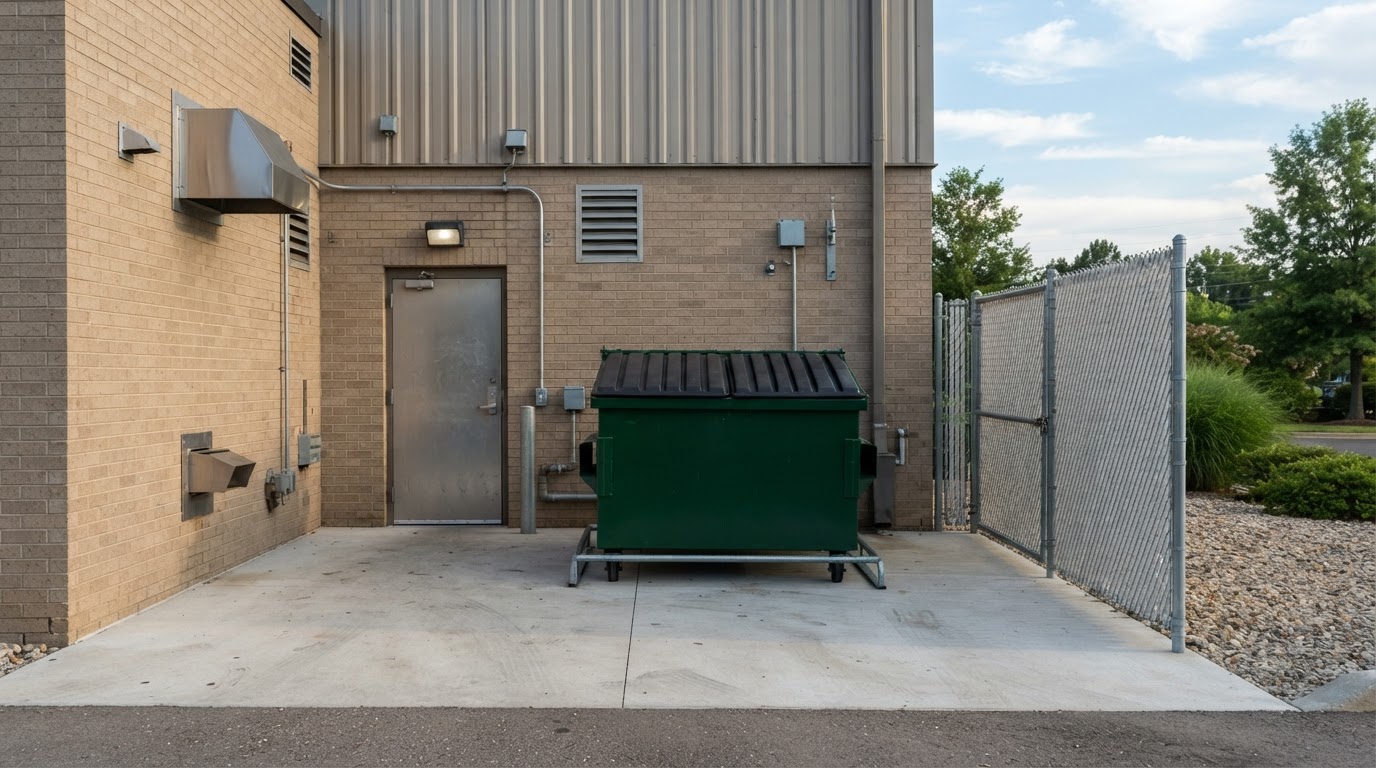
Presentation matters more here than anywhere else in commercial waste, so it is worth saying plainly what a visit involves. A truck arrives, the operator inspects the container, the drum works the load down, and the operator inspects it again and documents the before and after with photos. Nobody handles your waste by hand — that is a zero-touch policy — and nothing is dragged out of the enclosure.
Max Compacx schedules around your operations, which for a restaurant usually means well before or well after service and for a retail tenant usually means outside the center's delivery window. The practical result is a lower, tidier enclosure, and overflow beside the container is what customers actually notice.
Honest Limits
When compaction will not move your number
Max Compacx says this before anyone signs anything, because it is true often enough to matter. Compaction reduces haul-offs; it never eliminates them. If your container already leaves heavy, the air is not what you are paying for. If you are already down to one pull a month, there is not much schedule left to remove.
There are also materials we will not take on: liquids, dirt and aggregate or other dense no-air material, hazardous or regulated waste, sealed drums and pressurized vessels, and anything your hauler will not accept. And if you already bale your cardboard, the baler is doing most of this job.
Middle Georgia Context
The Middle Georgia angle
Retail and food service in Macon spreads along a handful of corridors rather than concentrating downtown. Stores and restaurants cluster near the interstate exchanges and the arterial roads, often in shared centers where several tenants split one enclosure. In the surrounding communities — Byron, Gray, Forsyth, Perry, Lizella, Centerville — a single shop or restaurant usually sits on its own pad with one container and a standing weekly pickup set years ago and never revisited.
Both situations reward the same audit. Shared enclosures reward it because right-sizing and compaction can keep a box from overflowing into the neighboring tenant's space. Standalone sites reward it because a schedule set at a different sales volume is almost always wrong now. Max Compacx serves Macon and Middle Georgia and works alongside approved local haulers rather than replacing them.
Our Take
Max Compacx's take
Retail and restaurant operators tend to treat the waste bill as a fixed cost of doing business, and it usually is not — it is a volume problem wearing a scheduling costume. The material coming out of a store is the best case for compaction in commercial waste, and most owners have never had anyone measure it.
Start with the free demo rather than a contract. If the numbers do not justify the service, we would rather say so than sell you a monthly visit that does nothing.
— Max Compacx
How We Can Help
How Max Compacx can help
Max Compacx rents 20-, 30-, and 40-yard roll-off dumpsters to commercial accounts across Macon and Middle Georgia, and provides on-site waste compaction on containers already in place — ours or the one your current hauler dropped. Two ways to start: keep your dumpster and hauler and let us compact it, or take the container and the compaction together.
To run the arithmetic on your own numbers first, use the waste calculator. The broader teach on trip economics lives in How Macon Businesses Cut Roll-Off Haul Costs.
FAQ
Frequently asked questions
See it on your own container
The demo takes about ten minutes, costs nothing, and uses the waste already sitting in your box. If it does not make sense for your site, we will tell you.
Max Compacx
5900 Hawkinsville Rd, Macon, GA 31216
478-722-3852office@MaxCompacx.com
Monday – Friday, 7am – 5pm