
Warehouse & Distribution
Cutting Waste Costs in Warehouse & Distribution
Why corrugate and film are mostly air, where a baler stops helping, and what compaction does in Macon.
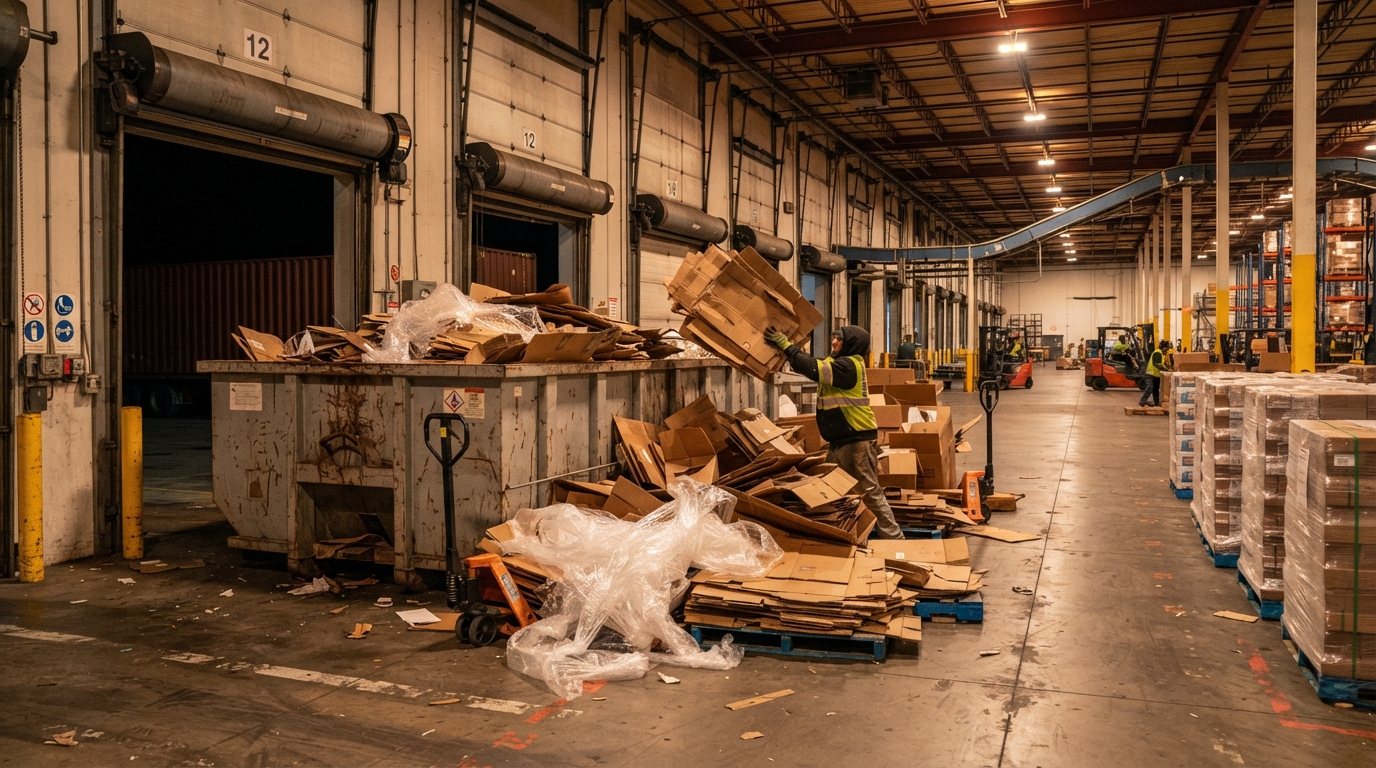
A distribution center pays to haul air. Cutting waste costs in warehouse and distribution starts with that one fact: the container leaving your dock is full of corrugate, stretch film, and void fill — material that is mostly empty space — and the hauling bill is written per trip, not per pound. Warehouse waste is the friendliest stream there is for volume reduction, which is also why so much of the spend on it is avoidable.
Max Compacx rents roll-off containers and performs mobile compaction on containers already sitting on your pad, and warehouse and distribution accounts around Macon are where the material cooperates most. Here is how the trip math actually works on a dock, what changes when you already run a baler, and where the remaining air is hiding.
Quick Answer
Quick Answer: What Cuts Warehouse and Distribution Waste Costs
- 1
You are billed per trip, not per pound.
A warehouse container almost always fills by volume long before it approaches its weight limit, so every pull is a truck moving mostly space.
- 2
Corrugate and film are the best-compressing materials we handle
the top row of the reduction table, 60–70%.
- 3
Cardboard-heavy operations approach 3:1,
meaning close to three containers' worth of loose material handled before the box has to leave, versus about 2:1 on general mixed waste.
- 4
Right-size before anything else.
One container doing dock trash, returns, and damaged goods at the same time is the most common source of wasted pulls.
- 5
Fix the pull schedule to reality, not to the calendar.
Standing weekly pickups outlive the volume that justified them, especially after peak.
- 6
A baler and on-site compaction solve different halves of the problem.
If you already bale corrugate, compaction targets everything the baler never touches.
- 7
Compaction reduces haul-offs; it never eliminates them.
A compaction visit is still a visit to your dock — it happens instead of a haul-off, not on top of one.
- 8
Low-volume docks may not benefit much.
If your container goes out once a month and comes back genuinely full, the arrangement is already working.
Volume Problem
Why Warehouse Waste Costs Are a Volume Problem
Every roll-off container has two ceilings. One is volume, the space inside the box. The other is payload — what the loaded truck is legally allowed to carry down the road. Whichever ceiling you reach first ends the load and triggers a trip. On a demolition site you hit weight almost immediately. On a dock you will essentially never hit it.
The numbers show the gap. A loose commercial load runs somewhere around two to three tons while looking completely full, and the same container packed with compressible material worked down properly can approach eight to twelve tons at roughly 95% of permitted DOT payload. A warehouse container of broken-down cartons and stretch wrap sits at the very bottom of that range. The truck that hooks it is legally capable of carrying several times what is on it, and the trip costs the same either way.
That is the whole warehouse cost problem in one sentence: the container reaches full before the truck reaches full. Everything below is about narrowing that gap. The general version of this math, written for any Macon business paying by the trip, is in the roll-off haul cost guide — this page is the dock-side version of it.
Material Breakdown
What a Distribution Center Actually Throws Away
On-site compaction reduces volume by up to 70%, and where a given material lands on that scale depends entirely on what it is:
| Material stream | Typical volume reduction |
|---|---|
| Cardboard, packaging, recyclables | 60–70% |
| Compost and organics | 50–60% |
| C&D debris, wood and pallets, mixed metals | 40–50% |
Warehouse and distribution waste sits mostly in the top row, which is the reason this vertical responds better than any other. But a dock produces more than corrugate, and the streams behave differently once you separate them:
| Warehouse stream | Why it fills the box | How it responds to compaction |
|---|---|---|
| Inbound corrugate, cartons, slip sheets | Nested, uncollapsed boxes are almost entirely air | Best case — top of the table |
| Stretch film, pallet wrap, banding, strapping | Springs back and bridges; occupies far more space than its weight | Strong, and the stream a baler usually skips |
| Void fill: air pillows, foam, kraft paper, dunnage | Purpose-built to be air | Strong |
| Damaged goods and unsellable returns | Odd shapes, packaging still on, leaves voids | Good, once packaging is separated |
| Broken pallets and wood dunnage | Rigid, awkward, stacks badly | Modest — bottom of the table |
| Mixed dock and break-room trash | Bagged air | Good |
| Wet or contaminated returns | Weight climbs, volume does not | Limited; watch the load |
Two things fall out of that table. First, the classic warehouse container is a near-ideal candidate, which is why cardboard-heavy operations plan around ratios approaching 3:1 rather than the 2:1 used for general mixed waste — roughly one or two compaction visits between pulls, with more material handled before each one. Second, reduction is always material-dependent. These are ranges that can be reached, not guarantees, and Max Compacx would rather show you the result on your own material than have you take the table on faith.
The Baler Question
If You Already Run a Baler, Read This Part
This is the honest section, and it matters more in warehouse and distribution than in any other vertical, because a lot of DCs have already solved half the problem.
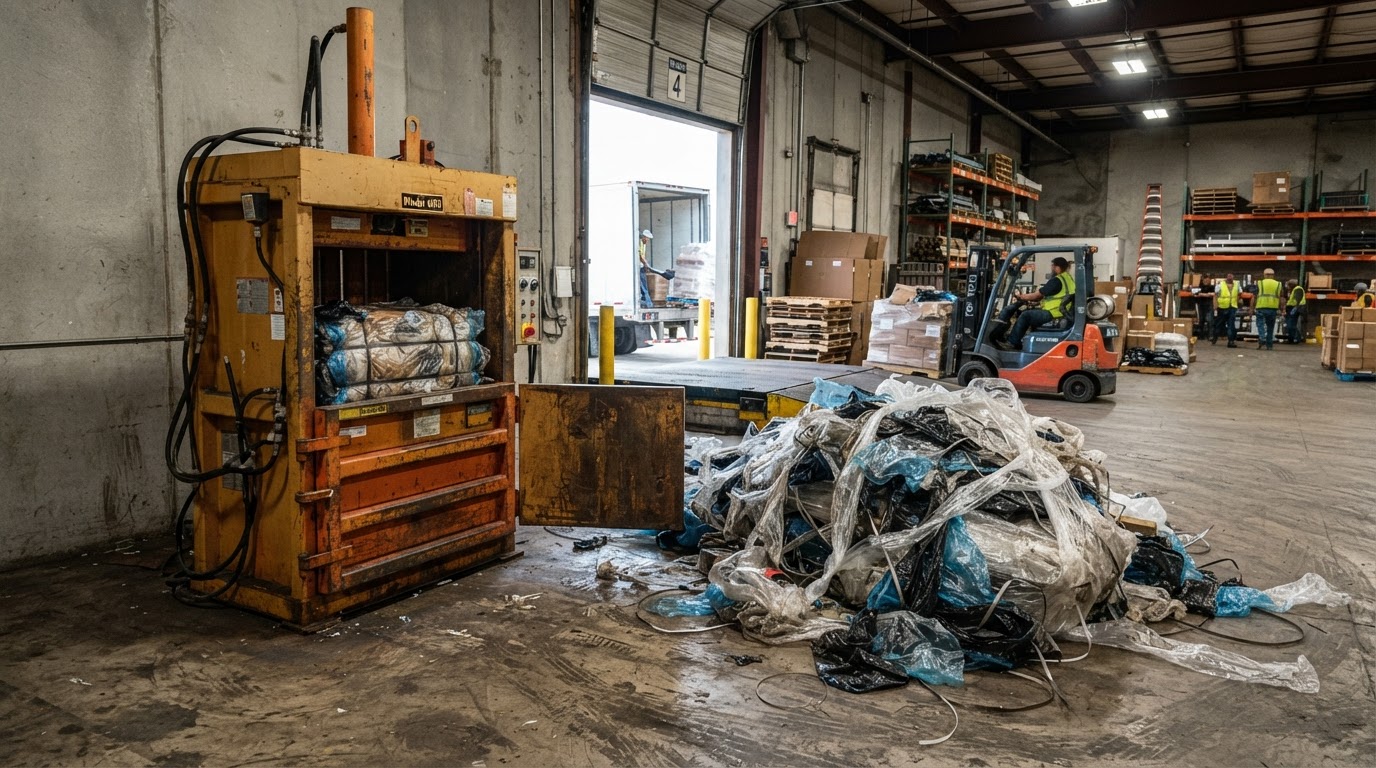
A baler and on-site compaction are not competing answers to the same question. A baler takes one clean, sorted, high-value stream — usually old corrugated containers — and turns it into a dense, marketable bale. That is a good outcome, and it is not one Max Compacx is going to argue with. What a baler needs in return is floor space near the dock, an associate walking cartons to it, wire and maintenance, and a stream clean enough to stay marketable.
Compaction works on the opposite end. It happens on a container already sitting on your pad, with nobody sorting anything, on whatever mixed material is in the box.
So the practical read for a baled operation is this: if your corrugate is already baled, the highest-value air in your waste stream is gone, and compaction targets what is left. In most warehouses that remainder is substantial — stretch film and banding, void fill, damaged goods with packaging still attached, mixed dock trash, broken pallets, break-room waste, seasonal and returns overflow. That material tends to go into a general container that nobody optimizes, and it is usually the container still going out half air.
There are cases where the answer is no, and Max Compacx says so on site:
Your general container already leaves genuinely full.
Look inside before the next pull. If there is no visible void space at the top and no springy material, there is nothing there to recover.
Volume is low and infrequent.
A single container pulled once a month is not a trip-count problem, and a compaction visit against it would just be another visit.
The remaining stream is dense.
Wet returns, heavy product, and dense no-air material do not compress meaningfully — and dirt, soil, aggregate, liquids, regulated waste, and sealed or pressurized vessels are outside what Max Compacx handles at all.
Baling is doing everything.
Some operations bale corrugate and film both, sort tightly, and produce very little general waste. That is a well-run dock, and it should stay as it is.
Four Levers
Four Levers That Cut Warehouse Waste Costs
In the order they usually pay:
- 1
Right-size the container for the volume, not for the habit.
Docks producing high volume from a steady inbound flow are usually undersized, which shows up as overfilled boxes and unscheduled pulls. The size breakdown covers what each container holds; a walk of your dock at 3pm on your busiest day decides the rest.
- 2
Break down what breaks down, before it goes in.
A carton thrown in whole occupies several times the space it needs to. Whole pallets, uncollapsed gaylords, and intact packaging leave voids no compaction visit fully recovers.
- 3
Match the pull schedule to what is actually in the box.
Standing pickups get set during peak and never get revisited. Count last quarter's pulls, then look inside the container before the next few and note how full it truly is.
- 4
Remove the air that is left.
Compaction handles the part a schedule change cannot fix — the corrugate, film, and void fill that make a full-looking box a light one.
Middle Georgia Context
The Middle Georgia Angle on Warehouse and Distribution Waste Costs
Macon sits where I-75 and I-16 cross, which is why so much of Middle Georgia's warehouse, distribution, and third-party logistics space ended up here. Sofkee Drive and the Hawkinsville Road corridor, the industrial parks along Sardis Church Road and Mead Road, the newer buildings out toward Byron and Perry along the I-75 spine — those buildings all generate the same waste profile: heavy inbound freight, high carton counts, and pallets of film coming off every load.
The regional detail that changes the math is seasonality. Distribution volume in this corridor moves in waves — retail peak, produce and agricultural seasons out of the south end of Middle Georgia, plant shutdown periods, and the returns surge that lands after every peak. Waste follows those waves, but standing pull schedules do not. A cadence set during the busiest six weeks of the year is still running in February on containers half full of air, and that is the single most common thing Max Compacx finds on a first visit to a Macon dock.
The other local factor is the yard itself. Dock aprons here are tight, trailer parking is at a premium, and a container sitting in a spot that blocks a trailer bay costs the operation something a hauling invoice never shows. Fewer haul-offs means fewer truck movements through that yard during shift hours. Max Compacx runs from a Hawkinsville Rd base in Macon and schedules service around dock operations rather than a fixed route, serving Macon along with Byron, Gray, Forsyth, Perry, Lizella, and Centerville. Coverage by area is on the service areas page.
Our Take
Max Compacx's Take
Our honest read is that warehouse and distribution is the easiest vertical we work in, and that is exactly why it deserves a careful look rather than an enthusiastic one. When material is this compressible, it is tempting to promise a lot. What we would rather do is put ten minutes on your own container and let you watch what happens to the top of the load.
If you already bale, we will tell you the baler is doing the valuable part and that our conversation is about the other container — the one nobody has looked inside in a year. If that one is genuinely full when it leaves, we will say so and there is nothing to sell. If it is full of film, void fill, and uncollapsed cartons, you will see the difference in the before-and-after photos, and you can decide from there.
The rule we hold ourselves to on a dock: measure it on your material, count your own pulls, and change the schedule before changing anything else.
— Max Compacx
How We Can Help
How Max Compacx Can Help
Max Compacx serves warehouses, distribution centers, and logistics operations across Macon and Middle Georgia with two things: commercial roll-off container rental in 20-, 30-, and 40-yard sizes, and mobile on-site compaction performed on a container right where it sits on your pad.
There are two ways to start. Keep the container and hauling company you already use and have us compact what is on your dock, so nothing about your existing arrangement or your approved local haulers changes. Or take container and compaction together as one service. We do not haul, so there is never a version of this where we need your hauling business.
Container sizing for high-volume industrial and distribution sites is on the industrial dumpster rental page. How a compaction visit runs on a working dock — drum narrower than the container, no hydraulic downforce, before-and-after inspection with photo documentation you keep — is on the on-site waste compaction page. The broader trip-economics guide for any Macon business is cutting roll-off haul costs in Macon. When you want the free demo on your own waste, request service or call and describe the dock.
FAQ
Frequently Asked Questions
See What Is Actually in Your Container
Tell us what comes off your docks in a normal week. Max Compacx will size the container to the volume, look at your pull cadence against what is really in the box, and run a free demo on material you already have so the result is yours and not a projection.
Max Compacx
5900 Hawkinsville Rd, Macon, GA 31216
478-722-3852office@MaxCompacx.com
Monday – Friday, 7am – 5pm
Serving Macon and Middle Georgia — including Byron, Gray, Forsyth, Perry, Lizella, and Centerville. Commercial and industrial accounts only.