
Mobile Waste Compaction
Mobile Waste Compaction in Macon: How It Works and What to Ask
How mobile waste compaction works in Macon: what a visit does, how much volume comes out, the five questions worth asking, and when it isn't worth doing.
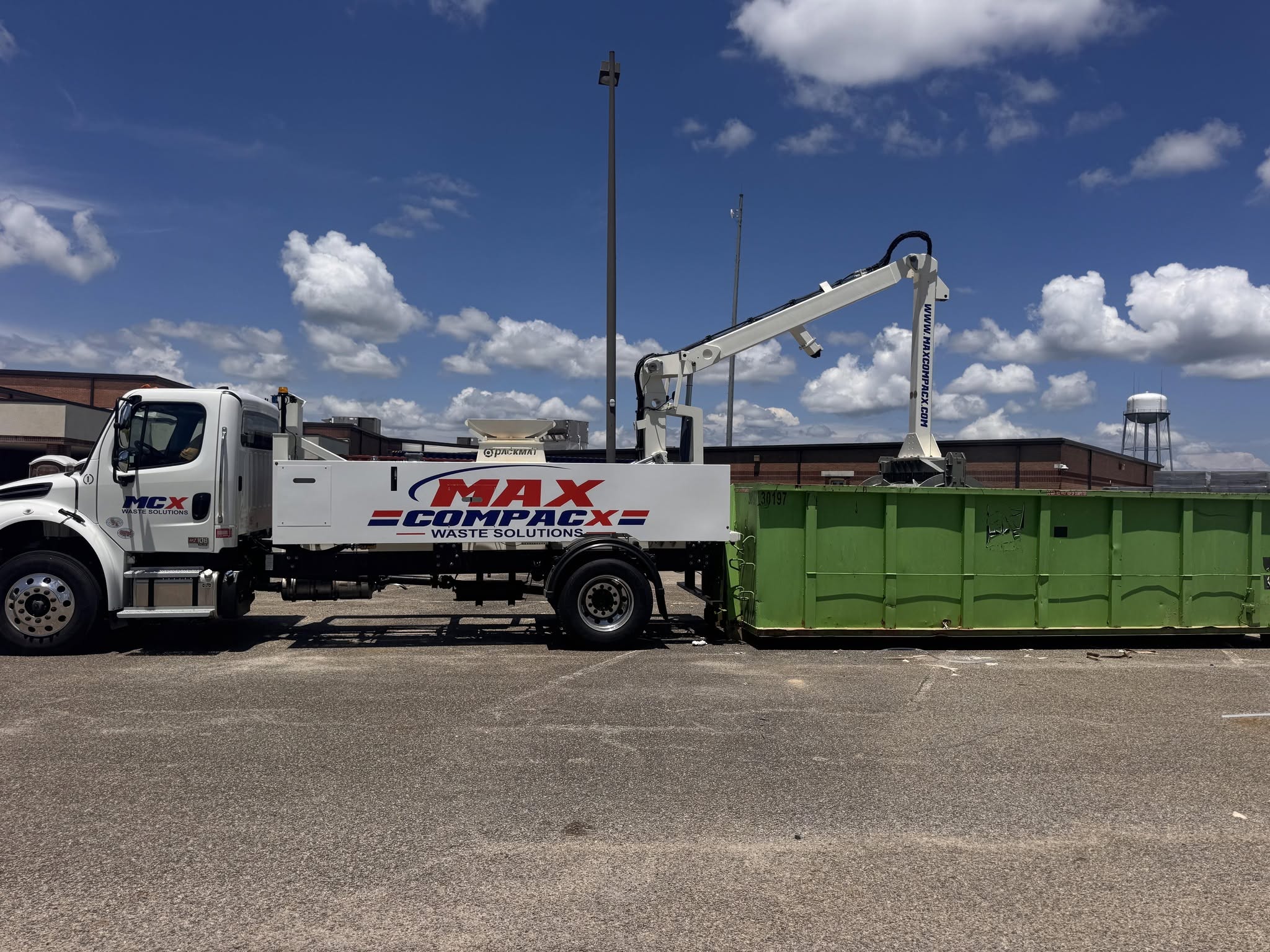
Mobile waste compaction in Macon is a service call, not a machine you install. A truck comes to a container already sitting on your property, works the load down inside it where it sits, and leaves — so more waste rides out in every haul-off and the container gets pulled less often. Nothing is bolted to your building, and nothing about the arrangement you already have needs to change.
This page covers what the service is, what happens during a visit, how much volume comes out of different materials, the five questions worth having answered before you let equipment work inside a container you are responsible for, and when compaction is not worth doing at all. Max Compacx runs this service on commercial and industrial sites around Macon, and the answers below are ours, in writing.
Quick Answer
Quick Answer: Mobile Waste Compaction in Macon at a Glance
The short version, for anyone skipping the page:
- 1
It is a visit, not equipment you install. A truck comes to your container where it sits, presses the load down, and leaves — about ten minutes on a typical box, with no installation, no electrical work, and no equipment lease.
- 2
Volume reduction runs up to 70%, and the material decides where you land. Cardboard and packaging give up the most trapped air. Dense material gives up almost none.
- 3
Weight is the number that settles it. A loose commercial load can fill a container by volume long before it comes near its weight allowance, while the same box could legally carry far more.
- 4
You keep your container and your hauling company. Compaction is added on top of what you already have — run your own numbers to see the effect.
- 5
Expect fewer haul-offs, not fewer trucks. Compaction reduces pulls, but never eliminates them, and a compaction visit is itself a visit.
- 6
On some waste streams it is not worth doing. Dense material and low-volume containers gain very little, and we say so early.
How It Works
How Mobile Waste Compaction Actually Works
Mobile waste compaction is performed on a container already in place, and the box does not move. A drum narrower than the container body is lowered into the load, presses it down under its own weight, and lifts back out — no hydraulic downforce driving against the container walls, with safeguard wheels and end guards keeping the drum clear of the sides and ends. On a typical container the run takes about ten minutes.
What that buys you is density. A container that looks full from the receiving door is usually forty to sixty percent air: boxes nobody broke down, pallets stacked at angles with voids underneath, packaging bridging across the walls. Take the air out and the container reaches a real load before it reaches the top.
Volume reduction runs up to 70%, and where your material lands on that scale depends entirely on what it is:
| Material stream | Typical volume reduction |
|---|---|
| Cardboard, packaging, recyclables | 60–70% |
| Compost and organics | 50–60% |
| C&D debris, wood and pallets, mixed metals | 40–50% |
Read that as a fit test rather than a promise. Packaging-heavy operations carry the most trapped air and gain the most when it comes out; construction debris, wood, and mixed metal improve less, and anything already dense gains very little. The compost and organics figures describe possible equipment performance, not automatic acceptance. Suitability and receiving-hauler acceptance must be reviewed for your actual stream.
Weight tells the same story. A loose commercial load frequently can fill a container by volume long before it comes near its weight allowance, while the same box could legally carry far more payload. Plan around 2:1 on mixed commercial waste and approaching 3:1 where the stream is cardboard-heavy, with one or two compaction visits between pulls. A container running twelve haul-offs a month can come down to four on a strong stream — 96 fewer haul-offs a year on that one box.
Results are estimates. They vary with waste volume, material mix, loading conditions, weight limits and hauling rates. Results can vary from load to load, even at the same site. Actual volume reduction and cost savings are not guaranteed. Compaction reduces volume, not weight. For a more accurate estimate for your site, call our team at (478) 722-3852.
The equipment and how it is operated are covered in more detail on the on-site waste compaction page.
On a Working Dock
What a Max Compacx Visit Looks Like on a Working Dock
Scheduling comes first, and it is built from your actual fill rate rather than a default interval — typically one or two visits between pulls, set around your dock hours so the truck is not in your receiving lane during the hour you need it most.
On site, the crew works the container where it already sits, which matters on the tight commercial pads common around Macon: a single-lane approach, a shared pad, a box wedged against a building line. The container is inspected and photographed before the drum goes in and again after it comes out, you keep the documentation, and a zero-touch policy means nobody on your crew handles anything. Then the truck leaves and your container keeps filling on top of a real load instead of a stack of voids.
Five Questions
What We Think Any Facility Should Ask — and Our Answers
Letting equipment work inside a container you are responsible for deserves real answers rather than adjectives. These are the five questions a facility should have answered before a first visit, with ours underneath each one.
Honest Limits
When Compaction Is Not Worth Doing
Max Compacx sells this service and will still tell you when to skip it, because the alternative is an arrangement that quietly returns nothing for a year.
Dense material gains almost nothing. Concrete, rubble, dirt and aggregate, dense scrap — there is little air in any of it to remove, and those materials are excluded from what we work anyway.
Low-volume containers rarely justify it. If your box goes out once a month and is not straining to get there, the trips you would save are few. Compaction earns its keep on containers that leave often.
Some streams are already handled. If you bale your cardboard, run a stationary compactor, or separate aggressively enough that loads go out heavy, the air is largely out before anyone arrives.
Sizing may be the real problem. Plenty of businesses are not under-compacted, they are mis-sized — dense waste in a large container that hits legal payload before it looks full, or light waste in a small one that fills constantly. That is a container decision rather than a compaction one, and the roll-off container page covers sizes. The wider set of levers on haul-off cost is laid out in how Macon businesses cut roll-off haul costs.
Two limits apply to the service itself. Compaction reduces haul-offs; it does not eliminate them. And it does not reduce the number of trucks entering your lot — a compaction visit is a visit. What changes is its character: a short on-site visit happens instead of a truck hooking your container, driving it to a disposal facility, and crossing a scale.
Middle Georgia
The Middle Georgia Angle
Macon sits where I-75 and I-16 cross, and the freight economy around that junction is exactly the waste profile mobile compaction was built for. Distribution centers and warehouses receive in corrugated cartons and generate packaging faster than anything else. Manufacturing along the industrial corridors runs a steady stream of film, banding, and mixed packaging, and retail centers and restaurants produce cartons daily in containers with no room to grow. Those are top-of-the-table streams — the 60–70% band — and they repeat every week.
Local geography matters too. A lot of Middle Georgia commercial sites are tight: shared pads, single-lane approaches, docks that cannot lose an approach at ten in the morning. The box has to be worked where it actually sits. Max Compacx is based in Macon and serves Macon along with Byron, Gray, Forsyth, Perry, Lizella, and Centerville, so visits are scheduled around your pad rather than around a route. Coverage by area is on the service areas page.
Our Take
Max Compacx's Take
Our honest read is that mobile compaction is a fit question, not a persuasion question. It does a great deal for a container full of trapped air and very little for a container full of dense material, and nothing anyone says changes which one you have. That is why the demo exists, and why it is measured on your own box instead of described over the phone.
So judge it on what you see in your own parking lot. Ask for the before-and-after, keep the photos, and hold the result against your actual pull schedule rather than against a percentage. If your stream turns out to be dense, low-volume, or already handled, compaction does not belong on it — and we would rather say that in ten minutes on your pad than three months into an arrangement.
— Max Compacx
How We Can Help
How Max Compacx Can Help
Max Compacx does two things for commercial and industrial accounts in Macon and Middle Georgia: mobile on-site compaction on a container right where it sits — ours or the one your hauling company owns — and roll-off container rental in 20-, 30-, and 40-yard sizes.
There are two ways to start. Keep your container and your hauler and add compaction visits on top, so nothing about your disposal arrangement changes and your pull frequency comes down. Or take container and compaction together if you are opening a site or consolidating several containers into one properly sized one. With compaction-only service on your existing hauler's container, we do not haul or replace that hauling arrangement.
The service itself is detailed on the on-site waste compaction page, and container sizes, delivery, and pickup are on the roll-off dumpster page. When you want the demo, request service or call the office.
FAQ
Frequently Asked Questions About Mobile Waste Compaction in Macon
See It on Your Own Container
The fastest way to find out what compaction does for your waste is to have it run on your waste. The demo takes about ten minutes and costs nothing, and if your material is not right for it you will hear that instead of a proposal.
Max Compacx
Macon, GA · Serving Middle Georgia
478-722-3852office@MaxCompacx.com
Monday – Friday, 7am – 5pm
Serving Macon and Middle Georgia — including Byron, Gray, Forsyth, Perry, Lizella, and Centerville. Commercial and industrial accounts only.