478-722-3852office@MaxCompacx.com
    5900 Hawkinsville Rd, Macon, GA
    Max Compacx — mobile waste compaction and roll-off dumpster service in Macon, GA
    HomeDumpster Rental FAQ
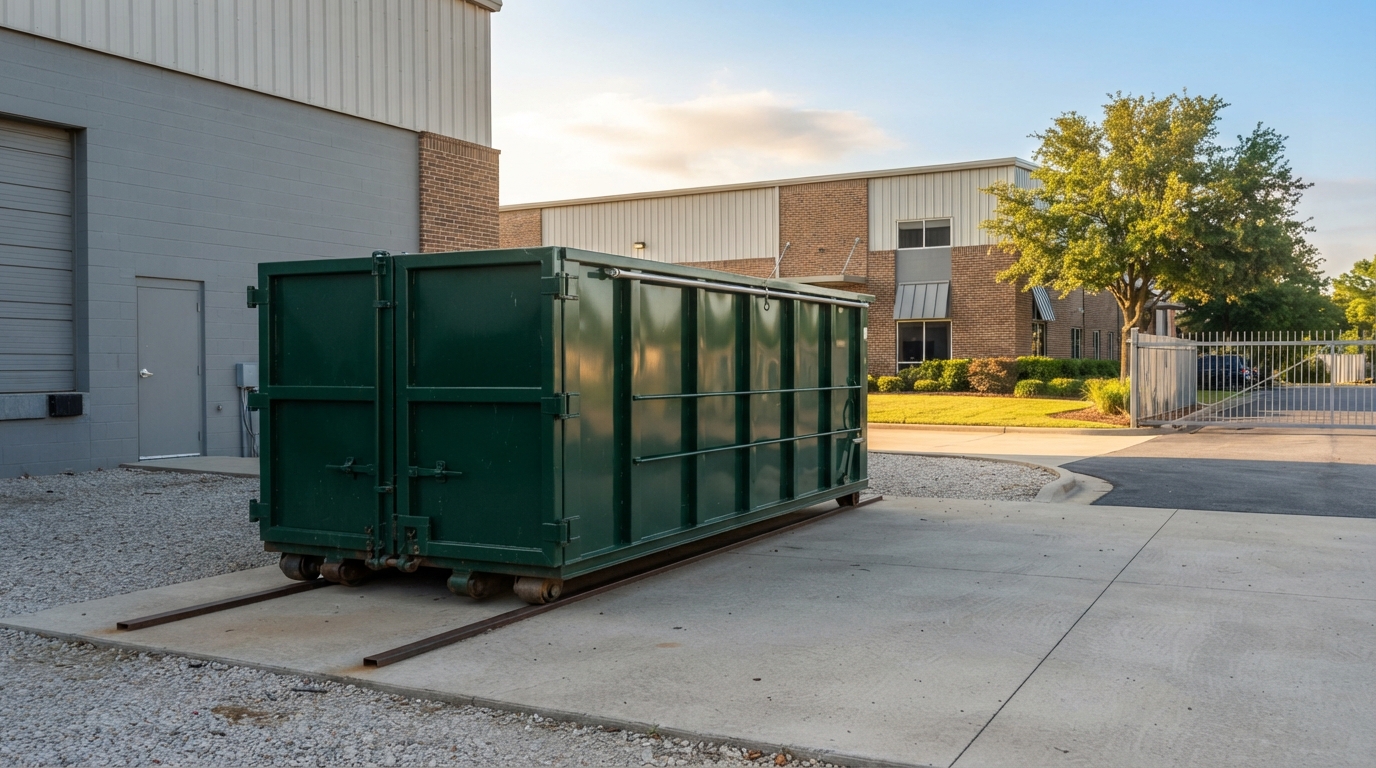
    A tidy roll-off container at a commercial site, calm and orderly

    Dumpster Rental FAQ

    Dumpster Rental FAQ — Macon, GA

    Answers to the questions Macon businesses ask before a container shows up — permits, placement, sizes, weight, and compaction.

    This dumpster rental FAQ answers the questions Macon businesses actually ask before a container shows up: permits and placement, what can go in the box, which size fits, how weight limits work, how the rental period runs, and what on-site compaction does. Max Compacx rents 20-, 30-, and 40-yard roll-off containers to commercial and industrial accounts across Macon and Middle Georgia, and performs mobile compaction on containers already in place. Everything below is written for business waste — we do not serve residential customers.

    Permits & Placement

    Dumpster Permits and Placement in Macon-Bibb

    Most commercial containers in Macon never touch a public street, which keeps the permit question simple for the majority of accounts. The complicated version comes up when the only workable spot is off your property, and that is a Macon-Bibb question rather than a hauling question. Where the container sits, what it sits on, and how much room the truck has are the three things worth settling before a delivery date is booked.

    No. A container placed on your own lot, pad, dock apron, or rear parking area is a private-property placement, and the approval that matters is from whoever controls that property — the owner, the landlord, or the property manager. Requirements can differ inside a business park or a leased center, so check your lease or association rules if you are not the owner. Delivery and placement expectations are covered on the roll-off dumpster rental page.

    That is a different question, and it involves the city rather than us. Requirements for placing a container in a public street, sidewalk, or right-of-way vary by jurisdiction and by location, and we do not guess at them or quote them secondhand. Tell us early if the right-of-way is your only option and Max Compacx will help you work out who to ask at Macon-Bibb before a truck is scheduled. Placement planning starts on the roll-off dumpster rental page.

    Anywhere on the property with a firm surface and a straight approach for the truck. Concrete pads and compacted gravel handle a loaded container well, asphalt is workable with protection, and soft ground after a wet stretch is a real risk. We set the container with the doors facing the way your crew loads, so tell us which side that is when you book. The roll-off dumpster rental page covers the full placement walkthrough.

    Yes. A loaded container is heavy, and asphalt can mark under sustained weight in Georgia summer heat — the same reason dock aprons and older lots get watched more carefully than concrete pads. If placement is on asphalt or anywhere surface marking is a concern, say so and we will bring boards to spread the load. Surface protection is part of the standard delivery discussion on the roll-off dumpster rental page.

    Roughly sixty feet of straight-line approach to set and retrieve the container, plus overhead space clear of power lines, low canopies, and dock awnings. Gates, bollards, and parked trailers are the three things that most often turn a scheduled delivery into a return trip. Walk the approach before delivery day and move what needs moving. Access notes for commercial sites are on the roll-off dumpster rental page.

    Materials

    What Can and Can't Go in a Roll-Off Dumpster

    Materials rules are not paperwork. They decide whether a loaded container can legally leave your lot, whether the receiving facility will accept it, and whether a scheduled pull turns into a rejected load and a return trip. The general shape is simple: ordinary commercial and construction waste is fine, dense no-air material and regulated material are not, and the receiving hauler has the final say on anything unusual.

    General commercial and industrial waste: cardboard, packaging, shrink wrap, pallets and wood, drywall, insulation, ceiling grid, fixtures and casework, retail and restaurant dry waste, mixed metals, and ordinary construction and demolition debris. If it is dry, non-hazardous, business-generated, and the receiving hauler accepts it, it belongs in the box. Anything you are unsure about is worth one phone call before it goes in. Material handling by container size is on the roll-off dumpster rental page.

    Liquids of any kind, along with dirt, soil, aggregate, and other dense no-air material. Hazardous or regulated waste is out, as are sealed drums and pressurized vessels, because nothing under pressure goes into a container that may be worked. One rule covers everything else: anything the approved local haulers will not accept is excluded, whatever it is, since the load has to be received somewhere at the end of the trip. The full exclusion list sits on the roll-off dumpster rental page.

    Yes. Macon-Bibb convenience centers are set up for household waste and yard debris from residents, and roofing material falls outside what they accept, so a truck of tear-off shingles has no free local drop-off and a rented roll-off becomes the practical option. Roofing debris goes to a permitted site that takes construction and demolition material, on a paid basis, and rules change — confirm current ones with the facility. Container sizing for shingle weight is on the roofing dumpster rental page.

    Yes. Dense material has to be declared before the container is set, because it changes the size we send, the pull schedule, the routing, and whether the receiving hauler will take it at all. A container loaded with rubble reaches legal road payload while the box still looks half empty, and an undeclared heavy load gets refused at the pull. Clean concrete and masonry removal is handled as a container-and-haul job rather than a compaction job — details on the demolition and concrete dumpster rental page.

    Sizes & Weight

    Sizes, Weight Limits, and Which Container Fits

    Max Compacx runs three roll-off sizes — 20, 30, and 40 yards — and the right one is decided by what your waste weighs as much as by how much of it there is. Two ceilings end every load: volume, meaning the space inside the box, and payload, meaning what the loaded truck is legally allowed to carry on the road. Whichever one you reach first is the one that sends the truck.

    It depends on whether your material is heavy or bulky. Dense waste wants a smaller container so the load reaches legal payload without wasted capacity, and light bulky waste wants the biggest box available so volume lasts longer between pulls. Most accounts start with a reasonable guess and adjust after the first cycle shows what the real volume looks like. The dumpster sizes page breaks all three down side by side.

    Footprint and capacity, and each one has a job. The 20-yard fits tight lots and shared parking and suits dense material that fills by weight. The 30-yard is the common default for mixed commercial and jobsite waste. The 40-yard is for light, bulky, packaging-heavy streams — it is rated well over fifteen tons of static load and it is where compaction returns the most, because there is the most air in the load.

    Yes. It is a road limit rather than a container limit: a roll-off can hold more than a truck is legally permitted to haul, so the load ends when it reaches payload even if the box has room left. For context, a loose commercial load often crosses the scale at around two to three tons while looking full, while a properly worked compressible load can approach eight to twelve tons at roughly 95% of permitted DOT payload. The weight-versus-volume discussion by size lives on the dumpster sizes page.

    Size to the material, declare dense loads before delivery, load flat and level, and keep the heavy fraction and the light fraction out of the same box where the job allows. Nothing above the top rail — a container loaded over the rails cannot be tarped, cannot legally travel, and turns a scheduled pull into a return trip. Masonry piled in one corner also puts weight where the truck does not want it. Sizing guidance for heavy streams is on the dumpster sizes page.

    Rental Period & Scheduling

    Dumpster Rental Period, Swaps, and Scheduling

    Max Compacx builds the rental term around how your operation actually runs rather than around a fixed block of days. Project work and ongoing commercial accounts behave differently, and the scheduling questions below come up on both. The short version: the container stays as long as the work does, and service is set against your dock hours instead of a fixed route.

    As long as the work takes. On project work the container stays for the duration of the job and gets swapped as it fills. On ongoing commercial accounts the container stays permanently and only the pull schedule is set, built around your actual volume. Rental terms by account type are on the roll-off dumpster rental page.

    A pull is a full container leaving and coming back empty, or not coming back at all if the job is finished. A swap is a full container leaving and an empty one taking its place in the same visit, so the site is never without a box. Swaps get scheduled ahead rather than called in the same day, which is what keeps a working site from stalling. Both are covered on the roll-off dumpster rental page.

    Clear the placement spot and the approach, confirm gates are unlocked and someone can move a parked trailer if one is in the way, and decide which direction the doors should face. If the surface needs protecting, say so when you book rather than when the truck arrives. Tell us about dense material at the same time, because it changes what we send. The full delivery checklist is on the roll-off dumpster rental page.

    Yes. Service is scheduled around dock operations rather than dropped into a fixed route, which matters most for plants and distribution centers where a truck in the wrong place at the wrong hour stops receiving. Tell us your loading windows, your shift change, and any hours the pad has to stay clear. Scheduling for commercial accounts is described on the roll-off dumpster rental page.

    Compaction

    On-Site Waste Compaction Questions

    The service that makes Max Compacx different from a standard container rental is mobile on-site compaction: a truck comes to your container where it already sits, works the load down, and leaves. It fits more waste in every load, which reduces how often the box has to be hauled. Volume reduction runs up to 70%, and where your material lands on that scale is decided entirely by what the material is:

    Material streamTypical volume reduction
    Cardboard, packaging, recyclables60–70%
    Compost and organics50–60%
    C&D debris, wood and pallets, mixed metals40–50%

    Results are material-dependent, always. Full detail is on the on-site waste compaction page.
    It is compaction performed on a roll-off container right where it sits, using a truck-mounted drum that works the load down inside the box. Nothing gets moved, and no equipment is installed on your property. It works on a container you already rent from someone else or on one we provide, so you can keep your existing hauler and change nothing about that arrangement. How a visit runs is on the on-site waste compaction page.

    No. The drum is narrower than the container so it works inside the walls rather than against them, there is no hydraulic downforce applied to the box, and safeguard wheels and end guards keep the drum off the container structure. We run a zero-touch policy on your equipment, inspect before and after, and document the container with photos you keep — and a 40-yard container is rated well over fifteen tons of static load. The safety detail is on the on-site waste compaction page.

    Up to 70%, depending entirely on the material — roughly 60–70% on cardboard, packaging, and recyclables, 50–60% on compost and organics, and 40–50% on C&D debris, wood, pallets, and mixed metals. In practical terms, plan around about 2:1 on mixed commercial waste and approaching 3:1 where the stream is cardboard-heavy, with one or two compaction visits between pulls. Those are planning figures rather than guarantees, and your own material decides. See the on-site waste compaction page for the full material table.

    When there is no air in your waste to remove, or not enough waste to matter. Dense streams like concrete, masonry, and rubble gain essentially nothing, and a business that only fills a container every few weeks may not generate enough trips for the arrangement to pay. Compaction also reduces haul-offs — it never eliminates them, and a compaction visit is itself a visit. Max Compacx will tell you when the answer is no; the honest read is on the on-site waste compaction page.

    Yes. It runs about ten minutes on waste you already have, on your own container, and includes a before-and-after inspection with photo documentation you keep. Nothing is measured on a sample load or a brochure — you watch what happens to your actual material, and if the result is unimpressive you will see that as plainly as we do. Book it from the on-site waste compaction page.
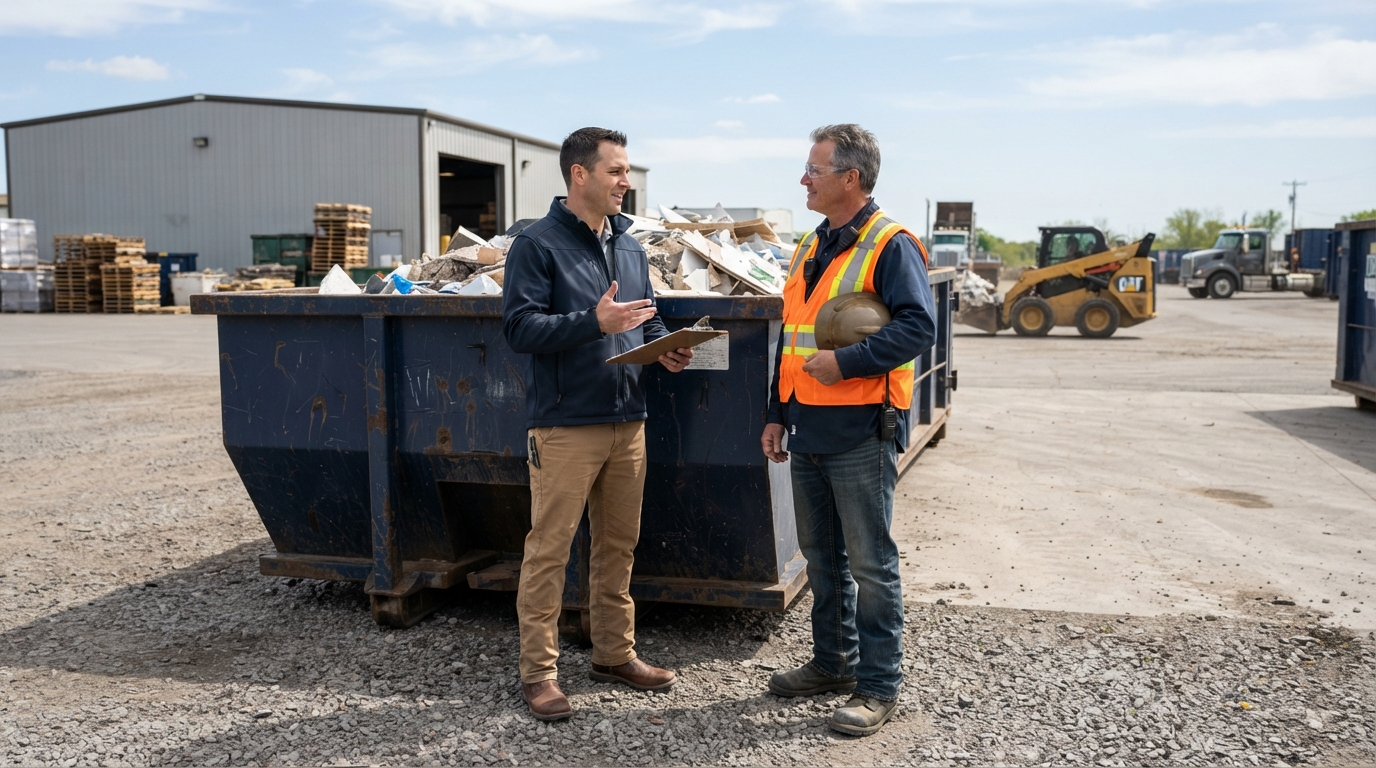
    A facility manager and an operator talking beside a roll-off container at a commercial site

    Still Have a Question About Your Container?

    Describe your site, your waste stream, and how often the box goes out. Max Compacx will tell you which container fits, what the materials rules mean for your material, and whether compaction changes anything on your stream — including when it does not.

    Max Compacx

    5900 Hawkinsville Rd, Macon, GA 31216

    478-722-3852

    office@MaxCompacx.com

    Monday – Friday, 7am – 5pm

    Serving Macon and Middle Georgia — including Byron, Gray, Forsyth, Perry, Lizella, and Centerville. Commercial and industrial accounts only. Coverage by area is on the service areas page.