
Property Management
Cutting Waste Costs Across Managed Properties
Turnover surges, one account, what compacts, and how to absorb peaks without extra pulls.
Waste costs across a managed portfolio are driven by the number of trips a truck makes, not by how much the property threw away, and most of those trips trace back to surges that were visible on a lease calendar months earlier. Cutting waste costs across managed properties comes down to two moves: size and schedule each property for its real baseline, then keep a way to absorb the peaks that does not involve ordering an unscheduled pull every time several units turn in the same week.
Max Compacx rents roll-off containers and performs mobile on-site compaction for commercial accounts across Macon and Middle Georgia, and property management is the vertical where the surges — not the baseline — decide what the year costs. This is written for the person running several properties at once: what actually moves the number, what does not, and how to tell which situation you are in.
Quick Answer
Quick Answer: What Cuts Waste Costs Across a Portfolio
- 1
You are billed per trip.
A container that leaves half full and a container that leaves properly full cost the same trip. Volume is the lever; tonnage rarely is on property waste.
- 2
The baseline is not the problem. The surges are.
Turn season, cleanouts, and storms produce most of the unplanned pulls in a portfolio year.
- 3
Sizing up permanently to survive a three-month surge
means a larger container occupying a resident-facing space for the other nine.
- 4
Property waste is mostly air.
Furniture, mattresses, carpet, bagged waste, and move-in cardboard compress well, which is why volume reduction works here.
- 5
Compaction absorbs surges in place.
The container stays the same size in the same corral and takes more before it has to leave.
- 6
One account across every property
removes the re-setup tax on new buildings and lets pull frequency be compared property against property.
- 7
Presentation is a real cost.
Overflow beside a pad on a leasing tour is not on any invoice, and it is usually the symptom of the wrong size or cadence.
- 8
Fewer haul-offs, never zero.
Compaction reduces trips; it does not replace a hauler, and a compaction visit is itself a scheduled visit.
Trip Economics
Why Cutting Waste Costs Across Managed Properties Starts With Trips
Roll-off service is billed by the trip. A truck comes, hooks the container, hauls it to a disposal facility, crosses a scale, and comes back. What that trip costs a property is essentially the same whether the box was packed tight or full of voids, which means the useful question is never "how much waste did this property produce" but "how many times did the container have to leave."
On property waste, the container almost always fills by volume long before it approaches a weight limit. A loose commercial load often crosses the scale somewhere around two to three tons while the box looks completely full. The same container, worked properly, can approach eight to twelve tons at roughly 95% of permitted DOT payload. The gap between those two numbers is trapped air — and on a portfolio full of mattresses, cabinet fronts, blinds, carpet, and half-collapsed moving boxes, there is a great deal of it.
That is the general shape of the argument, and it is covered in full in the Macon haul-cost guide. What makes property management different from a plant or a jobsite is the rhythm. A manufacturer produces a steady stream. A construction project has a start and an end. A managed property produces a flat baseline that runs forever, punctuated by bursts nobody can smooth out — and the container plan has to survive both.
The Surge Absorber
The Surge Absorber: Planning for Peaks You Face Three Months a Year
Every property portfolio has recurring volume events. None of them are emergencies if the container plan expects them:
Unit turnovers and suite flips
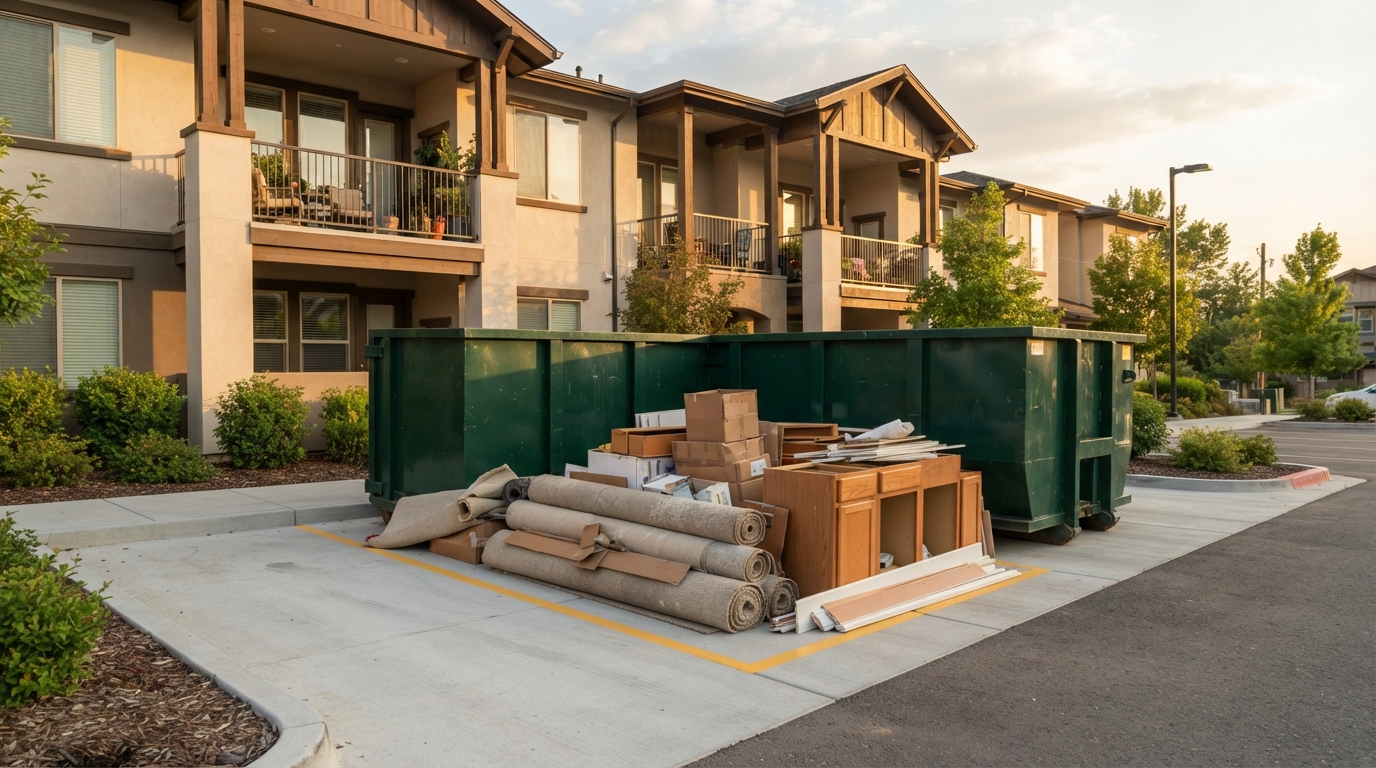
carpet, pad, blinds, appliances, cabinet fronts, and whatever the previous occupant left. One at a time is routine. Several in the same week is what breaks a schedule, and lease calendars make that concentration predictable a year in advance.
Recovered units
when a unit comes back with belongings still in it, the volume is household goods rather than construction debris: bulky, light, awkward to load. Georgia's process has its own required steps and timing, and that is your counsel's lane. On the container side it is a sizing and scheduling question, and furnished volume is consistently underestimated.
Bank-owned and foreclosure cleanouts
a property enters the portfolio with contents in place and everything has to leave before it can be listed, leased, or repaired. High volume, single visit, hard date.
Storm and weather cleanup
limbs, fence sections, soaked carpet, roof debris. On-call by nature, since volume depends entirely on what happened.
Common-area and amenity projects
clubhouse refreshes, pool furniture, corridor carpet, bulk-item collection days. Planned dates, which makes them the easiest surge to size for.
When one of those hits a container that was sized for the quiet weeks, there are four possible responses, and only three of them are real:
| Response to a surge | What it costs the property | When it is the right call |
|---|---|---|
| Order an unscheduled pull | A full truck trip against a budget that did not plan for it | Hard-deadline cleanouts, where the volume is genuine and the date will not move |
| Size up permanently | A larger box holding a resident-facing space year-round; needs pad room and light material | Properties whose baseline actually grew, not properties that spike |
| Compact the container in place | A short scheduled visit instead of a haul-off; footprint unchanged | Loads with air in them, on properties that pull often enough for the reduction to matter |
| Let it overflow | Overflow beside the pad, resident and tenant complaints, and usually an extra pull anyway | Never |
That third row is the surge-absorber frame, and it is the whole argument for compaction on managed property. A container that has been worked has room left in it when four units turn at once. The surge gets absorbed by the box already on the pad instead of triggering a Thursday phone call.
Material Recovery
What Actually Compacts on a Managed Property
On-site compaction reduces volume by up to 70%, and where a property lands on that scale is decided entirely by what the material is:
| Material stream | Typical volume reduction |
|---|---|
| Cardboard, packaging, recyclables | 60–70% |
| Compost and organics | 50–60% |
| C&D debris, wood and pallets, mixed metals | 40–50% |
Property portfolios sit across the whole table. Retail centers and office buildings run cardboard-heavy and land near the top. Multifamily turnover waste — furniture, mattresses, carpet, bagged household goods — compresses well because it is mostly air. Turnover debris carrying tile, plaster, or cabinet carcasses lands in the bottom band: real reduction, not the headline number. Treat the table as a fit test rather than a promise, because the result is material-dependent every time.
Two planning numbers follow from that. Plan around roughly 2:1 on mixed property waste, meaning about twice as much material before the container has to leave, with one or two compaction visits between pulls. Cardboard-heavy properties approach 3:1 — retail plazas and office buildings are the usual candidates.
Four Levers
Four Levers That Cut Waste Costs Across Managed Properties
In the order they usually pay:
- 1
Right-size per property, not per portfolio.
A 200-unit community and a six-suite office building do not need the same box. On older downtown Macon properties with one usable corral, access decides the size before volume gets a vote. The size breakdown covers dimensions.
- 2
Fix the cadence to reality.
Count last quarter's pulls property by property, then look inside the container before the next few pulls. If it is going out with voids at the top, the cadence is ahead of the volume. If overflow appears beside it, the cadence is behind.
- 3
Schedule turn season from the lease calendar.
Extra capacity staged ahead of a known concentration is cheaper than pulls ordered mid-surge, every time.
- 4
Remove the air.
On loads with air in them, compaction between pulls is what keeps the same container serving a bigger week. This is the lever that does not require more pad space or a bigger footprint.
Portfolio Structure
One Account Instead of Nine Separate Rentals
Portfolio structure is a cost lever people rarely count. When every property is its own rental with its own intake, three things go wrong: adding a building becomes a process instead of a phone call, nobody can compare pull frequency across properties, and the surge planning happens nine separate times or not at all.
Run as one account, with each property carrying its own size, cadence, and recorded placement instructions, the portfolio becomes measurable. You can see which property pulls twice as often as a comparable one, which container is leaving with voids in it, and which lease calendars concentrate hard enough to need staged capacity. Max Compacx sets accounts up that way as a matter of course, with billing that consolidates while keeping property-level detail, since disposal usually has to be allocated back to a specific property or owner.
The account structure for that is on the property management dumpster rental page. What matters for cost is simpler: you cannot reduce trips you are not counting.
Presentation
Presentation: The Cost That Never Reaches the Invoice
Contractors and plants never have to think about this one. Your container sits on a property people live in, lease space in, or shop at, and its condition is part of the site.
An overflowing box on the Saturday of a leasing tour has a cost that does not appear as a line item. So does a pile beside the corral that residents email about all week. In nearly every case the appearance problem is a symptom rather than a cause: the container is too small for what the property is currently producing, or the cadence is behind the volume, or a surge arrived that nothing was staged for. Correcting the size or the schedule usually clears the appearance with it.
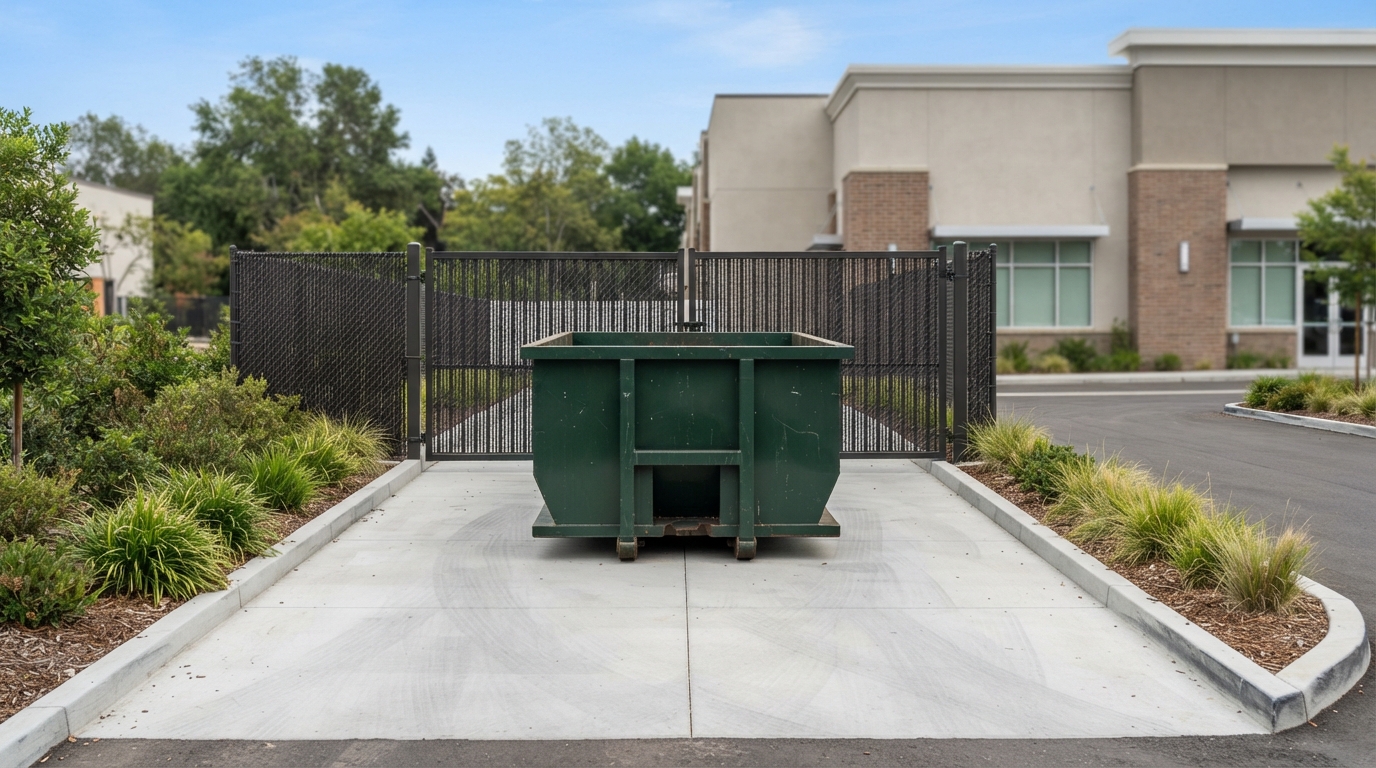
Compaction helps here for a plain reason — a container with room left in it does not become a pile beside it. Max Compacx works the load on the pad in about ten minutes, with nothing transferred to a second container and nothing spread on the ground, and placement is recorded per property so the box goes back to the same spot every time.
Honest Limits
When Compaction Will Not Move Your Number
Two situations, and Max Compacx will say so before anything is agreed to.
Not enough trips to reduce.
A small property that pulls a container rarely has almost nothing to work with. Reducing trips requires trips. Compaction visits on a container that leaves a few times a year are unlikely to change the arrangement meaningfully.
Not enough air in the load.
Dense material with no trapped air in it gains little. Dirt, soil, aggregate, and other dense no-air material sit outside what Max Compacx handles at all, along with liquids, hazardous or regulated waste, sealed drums and pressurized vessels, and anything the receiving hauler will not accept.
And the standing honesty rule:
compaction reduces haul-offs, it never eliminates them, and a compaction visit is itself a visit to the property. What changes is the character of the trip — a short visit on the pad happens instead of a truck hooking the container, hauling it to a facility, and coming back.
Middle Georgia Context
The Middle Georgia Angle on Property Waste Costs
Macon portfolios have a particular shape. The multifamily stock runs from newer suburban communities with room on the pad to converted and older downtown buildings where a shared alley and a single corral decide the container size for you. Sizing up is simply not available on many of those downtown properties, which makes working the container in place the only capacity move left.
Retail plazas and office parks along the I-75 and I-16 corridors run cardboard-heavy, and cardboard is where the reduction table reads best. Bibb County's mix of managed retail, office, and multifamily under the same management companies is also why portfolio accounts matter more here than in a market where a manager runs one asset type.
Weather is the other regional factor. Middle Georgia storm seasons put limbs, fence sections, roof debris, and soaked contents on the ground with no notice, and the property usually has to reopen before a normal schedule would allow. Dry storm debris is a volume problem that compacts reasonably. The same pile after two days of Georgia rain becomes a weight problem instead.
Max Compacx runs from a Hawkinsville Rd base in Macon and serves properties across Macon and Middle Georgia, including Byron, Gray, Forsyth, Perry, Lizella, and Centerville. Coverage by area is on the service areas page.
Our Take
Max Compacx's Take
Our honest read is that most property portfolios are not overpaying because they generate too much waste. They are overpaying because the container plan was built for an average week that never actually happens, so every real week is either a box going out with voids in it or a surge nobody staged capacity for.
If we were auditing a portfolio, we would start with last quarter's pull counts per property and one look inside the container before a scheduled pull. That single look answers most of it. A box going out full of air is a sizing or cadence question. A box going out genuinely packed is already doing its job, and nothing about the arrangement should change.
Where compaction earns its place on managed property is not the monthly average. It is the week four units turn at once and the container still has room in it.
— Max Compacx
How We Can Help
How Max Compacx Can Help
Max Compacx serves property management companies, multifamily owners, commercial landlords, and community associations across Macon and Middle Georgia with two things: roll-off container rental in 20-, 30-, and 40-yard sizes, and mobile on-site compaction performed on a container right where it sits.
There are two ways to start. Keep the container and hauling company you already use and have us compact what is on your pad, so nothing about your existing arrangement changes. Or take container and compaction together as one service. We do not haul, so there is no version of this where we need your hauling business.
Account structure, turnover scheduling, placement, and sizing by property type are on the property management dumpster rental page. How a compaction visit runs on an occupied property is on the on-site waste compaction page. The broader trip-economics guide behind this article is cutting roll-off haul costs in Macon. When you want the demo, request service or call and describe the portfolio.
FAQ
Frequently Asked Questions
Get a Read on Your Own Portfolio
Tell us how many properties you manage, what they produce, and how often the containers leave now. Max Compacx will size the containers, set one account across every property, and say plainly whether compaction changes anything for you.
Max Compacx
5900 Hawkinsville Rd, Macon, GA 31216
478-722-3852office@MaxCompacx.com
Monday – Friday, 7am – 5pm
Serving Macon and Middle Georgia — including Byron, Gray, Forsyth, Perry, Lizella, and Centerville. Commercial and industrial accounts only.