
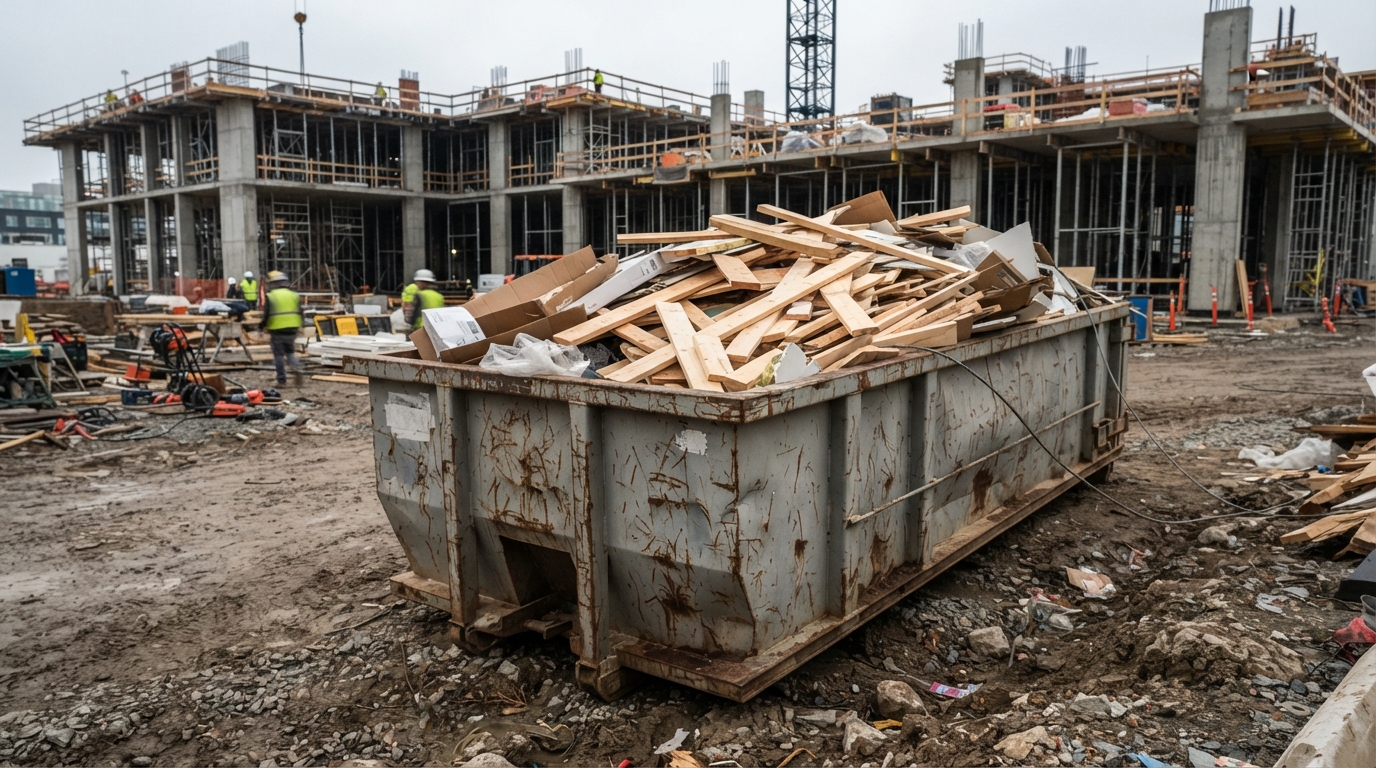
Construction
Cutting Waste Costs on Construction Projects
Phase-by-phase waste, swap-trip math, and where mid-project compaction earns its place.
Waste on a jobsite is billed by the trip, so cutting waste costs on construction projects is mostly a question of how many times a truck has to come get your container. The material changes every phase, the fill rate changes with it, and a container spec that made sense during sitework is usually the wrong one by the time the finish crews show up. Most of the money leaks in that gap.
Max Compacx rents 20-, 30-, and 40-yard roll-off containers to commercial jobsites in Macon and performs on-site compaction on containers already in place. This is the honest version of what moves the trip count on a construction project, phase by phase — including the phases where compaction does very little.
Quick Answer
Quick Answer: What Actually Cuts Construction Waste Costs
- 1
The swap trip is the unit of cost.
Not the tonnage, not the days on site — the number of times a truck hooks a box and hauls it away.
- 2
Waste changes shape every phase.
Demolition and sitework debris is dense. Framing, dry-in, and finish debris is mostly air. One container plan across all of them wastes trips at both ends.
- 3
Right-size by phase, not by project.
A 20-yard box for heavy phases, a 30 or 40 for bulky ones. Swapping the size mid-project is usually cheaper than swapping the box more often.
- 4
C&D debris sits at the modest end of the compaction table
40–50%, below cardboard and organics. Real, useful, not dramatic.
- 5
Mid-project compaction belongs on the high-air phases.
Dry-in through finishes is where a compaction visit does its best work on a jobsite.
- 6
Dense loads have to be declared before the container is set
concrete, masonry, and rubble change the size, the routing, and what the hauler will accept.
- 7
Dirt, soil, and aggregate are outside what Max Compacx handles,
along with liquids, regulated waste, and sealed or pressurized vessels.
- 8
Fewer haul-offs, never zero.
Compaction reduces swap trips; it does not eliminate them, and a compaction visit is itself a visit to your site.
Trip Economics
Why a Jobsite Pays by the Trip, Not by the Ton
Every roll-off container on your site has two ceilings. One is volume, the space inside the box. The other is payload, meaning what the loaded truck is legally allowed to carry on the road. Whichever ceiling you hit first ends the load and triggers a trip. Sitework and demolition debris hits weight. Almost everything after it hits volume, often with the box holding a great deal of trapped air when it leaves.
The gap between those two states is larger than most superintendents expect. A loose commercial load frequently crosses the scale at roughly two to three tons while looking completely full. That same container, loaded with compressible material that has actually been worked down, can approach eight to twelve tons at roughly 95% of permitted DOT payload. During the framing, dry-in, and finish phases, a jobsite container is usually leaving nearer the bottom of that range than the top.
Here is the swap-trip math in the only currency that matters on a schedule. Say a 30-yard box fills every four working days during finishes, and the phase runs three weeks. That is roughly four swaps. Work the same material down at around 2:1 and the phase needs about two — with one or two compaction visits between pulls instead of the truck trips they replaced. Same debris, same schedule, fewer times a truck has to find your gate.
| Finish-phase container | Days to fill | Swaps in a 3-week phase |
|---|---|---|
| Loose fill, no compaction | ~4 | ~4 |
| Worked down at roughly 2:1 | ~8 | ~2, plus 1–2 compaction visits between pulls |
Those are planning figures on mixed jobsite waste, not a promise about your material. Ratios move with what is in the box, which is exactly why the next section exists. The full trip-economics teach, written for any commercial waste stream, is in cutting roll-off haul costs in Macon.
Phase Breakdown
Construction Waste Changes Shape Every Phase
The reason a single container plan underperforms across a whole project is that a construction project is really five or six different waste streams arriving in sequence. Each one has a different reason for ending the load, and each one responds differently to being compacted.
| Project phase | Dominant debris | What ends the load | Compaction fit |
|---|---|---|---|
| Sitework, demo, slab breakout | Concrete, masonry, rubble | Legal payload, early | Little to none — no trapped air to remove |
| Structural and framing | Wood offcuts, banding, pallets, scrap metal | Volume, with weight climbing | Moderate — voids in stacked offcuts |
| Dry-in and envelope | Wrap, cartons, roofing scrap, insulation bags | Volume, well before weight | Strong — high air content |
| MEP rough-in | Conduit and pipe offcuts, spools, fitting cartons | Volume | Good on the packaging fraction |
| Drywall and finishes | Board scrap, cartons, fixture and appliance packaging | Volume, box goes out light | Strongest phase on the job |
| Punch and final cleanout | Mixed bulky debris, protection material | Volume | Good, though the stream is inconsistent |
Read that first row carefully, because it sets up the honesty of everything below it. A container going out full of broken slab is not a compaction problem. It is already leaving at legal payload, and Max Compacx will say so rather than schedule a visit that returns nothing. If a project is heavy on concrete and masonry removal, the demolition and concrete dumpster rental page covers the weight discussion properly.
The four middle rows are the opposite situation. From dry-in through finishes, jobsite containers are hauling a great deal of air — pallet wrap, cartons that came around fixtures, board scrap standing on edge, insulation bags, whole appliance boxes. That is the fraction worth working, and it happens to be the longest stretch of most commercial projects.
Compaction Reality
What C&D Debris Actually Does Under Compaction
On-site compaction reduces volume by up to 70%, and where any given material lands on that scale is decided by what the material is:
| Material stream | Typical volume reduction |
|---|---|
| Cardboard, packaging, recyclables | 60–70% |
| Compost and organics | 50–60% |
| C&D debris, wood and pallets, mixed metals | 40–50% |
Construction and demolition debris sits in the bottom row, and that is the number to plan against on a jobsite. It is the modest end of the table. Wood, drywall scrap, and mixed jobsite waste carry less trapped air than clean packaging does, and the reduction is material-dependent every time — it can and often does land in that 40–50% band, but nothing about it is guaranteed.
There is one honest exception worth knowing. During dry-in and finishes, some jobsite containers run genuinely cardboard-heavy — cartons off fixtures, appliances, millwork, and equipment deliveries. A box like that behaves more like the top row than the bottom one. Ratios follow the same logic: plan around roughly 2:1 on mixed waste, with streams approaching 3:1 only when the load really is cardboard-dominant.
The planning rule Max Compacx gives construction customers is to expect the low end, then let the demo on your own debris tell you whether your material does better. Ten minutes on a container you already have settles it more honestly than any table can.
Where It Pays
Mid-Project Compaction: Putting It Where It Pays
Compaction on a jobsite is not a decision you make once at mobilization. It is something you schedule into the phases that generate air and leave off the phases that generate weight.
The practical pattern is one or two compaction visits between pulls during dry-in, rough-in, and finishes. The visit happens on the container where it already sits, so nothing gets hooked, hauled, weighed, and brought back. It runs against your gate hours rather than a fixed route, which on an active site matters more than the compaction itself — a truck arriving mid-pour helps nobody.
Three things make mid-project compaction work on a construction site:
1. Start it when the stream turns bulky.
Not at mobilization. The first compaction visit should land when the box starts filling on volume rather than weight — usually at dry-in.
2. Keep the heavy fraction out of the bulky box.
Slab breakout, masonry, and rubble riding along with finish debris means the truck maxes on weight while the light material stays uncompacted. Where the phase plan allows, run them separately.
3. Stop when the stream turns dense again.
Demo backcharges, tear-outs, and heavy punch material can flip a container back to a weight-limited load. When that happens, skip the visit.
Max Compacx works either arrangement on a jobsite. Keep the container and hauling company you already use and we compact what is on your pad, or take container and compaction together as one service. We do not haul, so there is never a reason for us to argue for more trips than the job needs.
Four Levers
Four Levers That Cut Jobsite Waste Costs
In the order they usually pay on a construction project:
- 1
Size by phase.
Dense phases want a 20-yard box, framing a 30, dry-in through finishes a 40. A 40-yard container full of masonry cannot legally leave your site. The container size breakdown covers dimensions; the phase decides the choice.
- 2
Fix the pull schedule to reality.
Standing weekly pulls set at mobilization keep running through phases that fill in half the time and phases that barely fill at all. Look in the box before each pull for two weeks and the pattern shows itself.
- 3
Break down what breaks down.
Whole cartons, uncut wrap, and stacked offcuts leave voids that no amount of scheduling recovers. A crew flattening as it goes never creates them.
- 4
Remove the remaining air with compaction.
Once the first three are handled, what is left in the box is trapped air, and that is the part a compaction visit takes out.
Middle Georgia Context
The Middle Georgia Angle on Construction Waste Costs
Commercial construction around Macon has a shape worth planning for. The I-75 and I-16 corridors carry distribution and light-industrial work where the envelope and fit-out phases generate cardboard and wrap by the container. Downtown Macon runs adaptive reuse and tenant build-outs on tight sites where a container sits in a shared alley or a single-lane approach and swap timing has to be exact. Byron, Perry, Centerville, Forsyth, Gray, and Lizella have been steady with commercial pads, retail shells, and warehouse expansions, which means long dry-in and finish phases — the highest-air stretch of any project.
Georgia weather is the other jobsite factor. Rain turns wood scrap, drywall, and insulation from a volume problem into a weight problem overnight, and an uncovered container that filled on volume Friday can max on payload by Monday. Loading below the rails and getting a bulky container worked down before a wet stretch is cheaper than discovering it at the scale. Nothing above the top rail can be tarped or legally travel, and a refused pull is the most expensive trip on any job.
One more Middle Georgia specific: red clay and excavated soil are not on our list. Dirt, soil, and aggregate sit outside what Max Compacx handles, along with liquids, hazardous or regulated waste, and sealed or pressurized vessels, plus anything the receiving hauler will not accept. Sorting that before a container is set saves a wasted delivery.
Max Compacx runs from a Hawkinsville Rd base in Macon and schedules against jobsite hours rather than a fixed route, serving Macon and Middle Georgia. Coverage by area is on the service areas page.
Our Take
Max Compacx's Take
Our read after enough jobsites is that construction waste costs are a phase-timing problem wearing a container costume. Most projects buy one container arrangement in preconstruction and run it unchanged for eight months, which means it is wrong for roughly six of them. The fix is not exotic — it is looking in the box before the pull, and changing the size or the cadence when the material changes.
On compaction specifically, we will tell you plainly that C&D debris is the modest end of our table. It is not cardboard. What makes it worth doing on a construction project is not the percentage — it is the length of the dry-in-through-finishes stretch, where a jobsite generates air week after week and the container leaves light every time. That is a lot of trips to work on.
The rule we hold ourselves to on a jobsite: size it for the phase you are in, declare what is heavy, and only compact what has air in it.
— Max Compacx
How We Can Help
How Max Compacx Can Help
Max Compacx works with general contractors, subcontractors, and commercial developers across Macon and Middle Georgia on two things: roll-off container rental in 20-, 30-, and 40-yard sizes, and mobile on-site compaction performed on a container right where it sits.
There are two ways to start. Keep the container and hauling company you already use and have us compact what is on your jobsite, so nothing about your existing arrangement changes. Or take container and compaction together as one service, sized and scheduled by phase.
Container sizing, delivery, and swap logistics for a single jobsite are on the construction dumpster rental page. If you run several sites at once and want one account across all of them, that is the contractor dumpster rental page. How a compaction visit runs on an active site is covered on the on-site waste compaction page, and the broader trip-economics guide is cutting roll-off haul costs in Macon. When you want the demo, request service or call and describe the phase you are in.
FAQ
Frequently Asked Questions
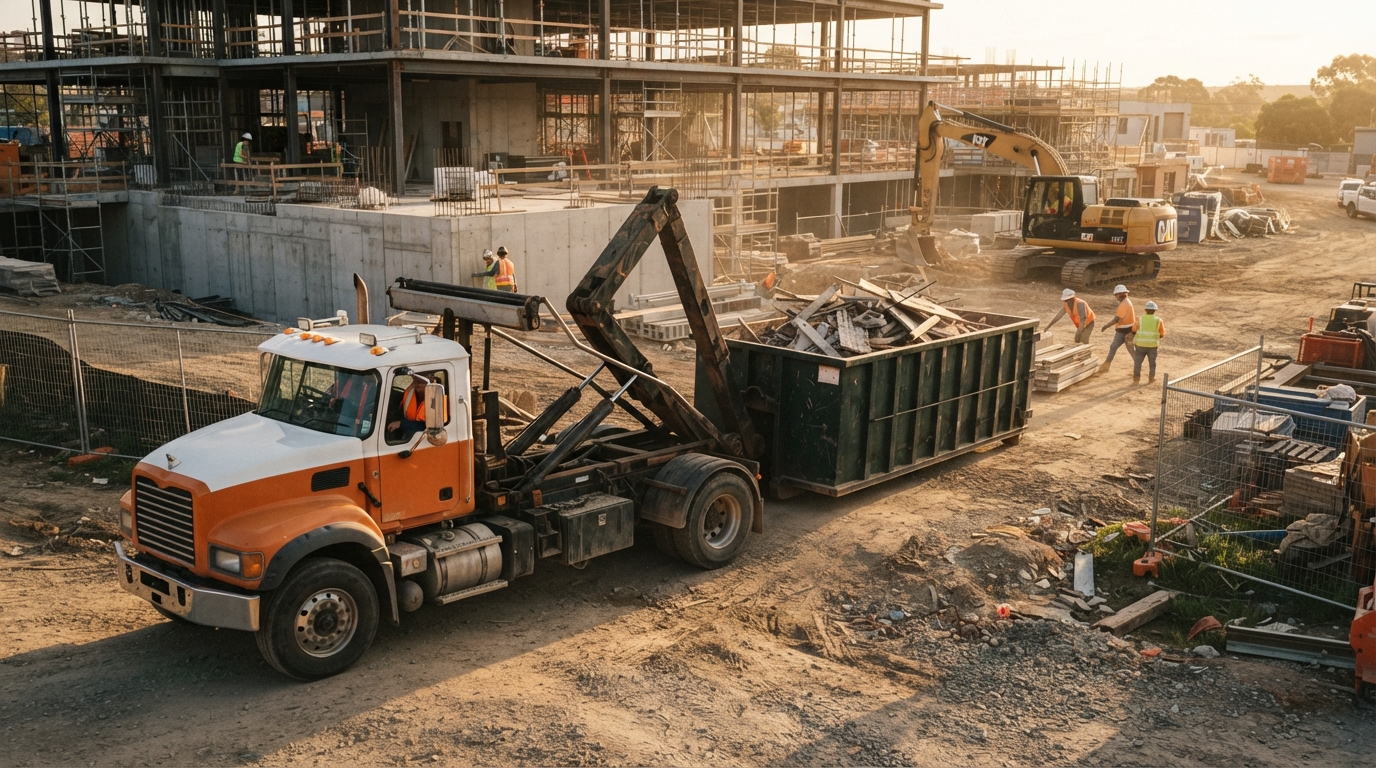
Tell Us What Phase You're In
Describe the project, the phase, and what is going in the box. Max Compacx will size the container for the material you actually have, put compaction only where it earns its place on the schedule, and tell you plainly if the answer on your jobsite is no.
Max Compacx
5900 Hawkinsville Rd, Macon, GA 31216
478-722-3852office@MaxCompacx.com
Monday – Friday, 7am – 5pm
Serving Macon and Middle Georgia — including Byron, Gray, Forsyth, Perry, Lizella, and Centerville. Commercial and industrial accounts only.